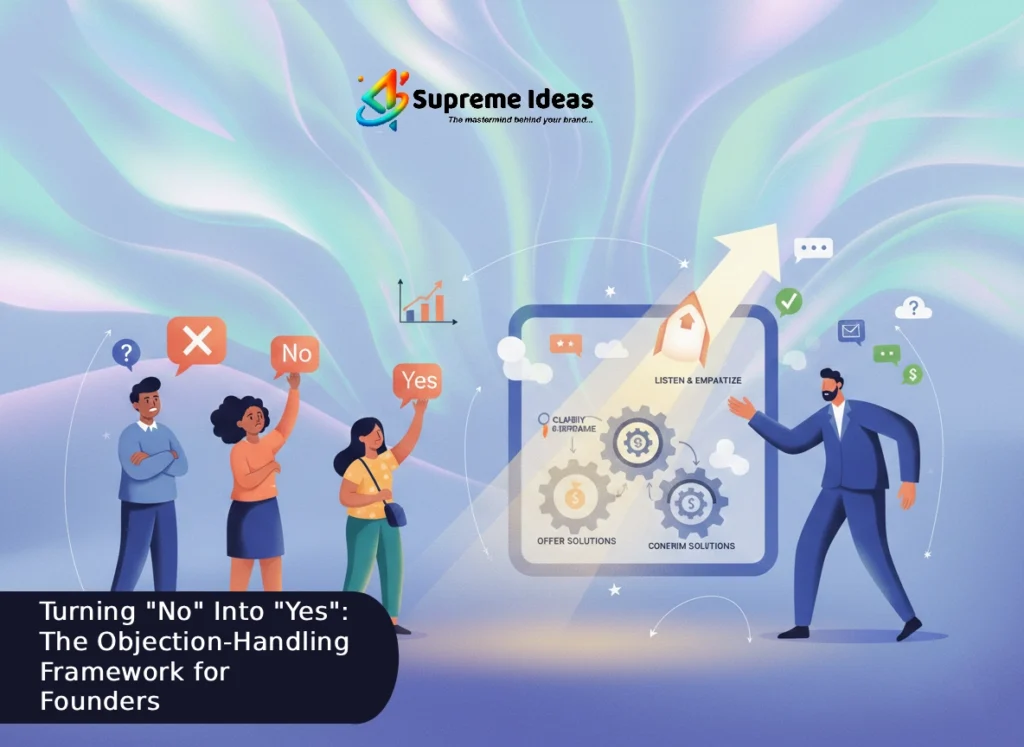
I remember my first real sales call for my own product. i had spent months building the thing. i had perfected the pitch deck. i was on the phone with a perfect prospect, i delivered the pitch flawlessly, and then i dropped the price. there was a pause. and then the prospect said, “yeah, this looks great, but it’s just not in the budget right now. let me think about it and get back to you.”
i froze. i said, “okay, totally understand, talk soon.” and i hung up.
i never heard from them again.
most founders treat a “no” like it’s a brick wall. they hear an objection and they instantly revert to their default programming, which is usually a mix of panic, defensive ego, and an overwhelming desire to flee the conversation. they assume that because the prospect said “no,” the product must be flawed, the price must be too high, or the market just isn’t ready.
that is a fundamental misunderstanding of human psychology.
a “no” is rarely a rejection of your product. a “no” is a defense mechanism. it is a reflex. when you ask a human being to part with their money, their brain immediately perceives a risk. their lizard brain lights up and tells them that making a decision could lead to a loss of status, a loss of resources, or making a fool of themselves. so they throw out an objection to buy time. they throw out an objection to test you.
if you back down the second you hear a “no,” you aren’t doing sales. you’re just taking orders. and order-takers don’t build empires.
this is the definitive guide to handling objections. not with slimy, high-pressure car salesman tactics, but with a framework built on radical empathy and diagnosis. we are going to look at why people lie to you on sales calls, how to isolate the real problem, and how to turn a defensive reflex into a confident “yes.”
if you master this, you won’t just close more deals. you will fundamentally change how you interact with other human beings.
The Anatomy of an Objection: Why Prospects Lie to You
before you can handle an objection, you have to understand where it comes from. the first thing you need to realize is that prospects almost never tell you the real reason they aren’t buying.
it’s not because they are malicious. it’s because humans hate conflict.
imagine you are on a demo call for a new CRM software. you realize halfway through that the software is way too complicated and you honestly don’t beleive you have the technical skills to implement it. are you going to look the founder in the eye and say, “i’m not buying this because i’m secretly insecure about my own tech skills and i’m terrified i will fail to roll this out to my team”?
no. you are going to say, “this looks amazing, but it’s just a little out of our budget right now. send me a proposal and i’ll review it with my partner.”
the founder hangs up and thinks it’s a pricing issue. they spend the next three days trying to figure out how to offer a discount. but the price was never the problem. the problem was a lack of trust in their own competence.
Good vs. Bad Approaches to the Initial “No”
-
The Bad Approach: Taking the first objection at face value and immediately trying to solve it. “Oh, it’s too expensive? What if i knock 20% off?” This is terrible. You just signaled that your original price was fake, and you haven’t even addressed their actual underlying fear.
-
The Good Approach: Treating the first objection as a symptom, not the disease. You acknowledge it, but you don’t immediately try to fix it. You probe deeper to find the root cause.
you have to assume that the first objection is a smokescreen. your job is to clear the smoke before you start fighting the fire.
The Three Categories of Objections
to clear the smoke, you need to mentally categorize the objection the second it leaves the prospect’s mouth. every objection falls into one of three buckets. if you misdiagnose the bucket, you lose the deal.
Bucket 1: The Smoke (Stall Tactics)
this is the polite rejection. it is designed to get you off the phone without hurting your feelings.
-
Examples: “I need to think about it.” “Send me some more information in an email.” “Call me back next quarter.”
-
The Reality: They do not need to think about it. Nobody sits in an armchair by a fireplace pondering your B2B software for three weeks. They have already made a decision, and the decision is no, but they don’t want the awkwardness of saying it. If you accept a stall tactic, you are just agreeing to a slow death.
Bucket 2: The Mirror (Internal Fears)
this is when the prospect is reflecting their own internal insecurities onto your product. they trust your product works, but they don’t trust themselves to make it work.
-
Examples: “I just don’t have the time to implement this right now.” “My team is really resistant to change.” “We tried something like this last year and it failed.”
-
The Reality: They are terrified of making a mistake. The pain of the status quo is currently less scary to them than the pain of potential failure. Your job here is not to explain more features; your job is to lower their perceived risk.
Bucket 3: The Wall (Logistical Dealbreakers)
these are actual, physical barriers to the sale. they are rare, but they do exist.
-
Examples: “We are locked into a contract with your competitor for the next 18 months.” “I am not the authorized decision-maker, my CEO has to sign off.” “I literally have zero dollars in my bank account.”
-
The Reality: You cannot overcome a true wall with clever wordplay. If they literally do not have the money or the authority, the sale cannot happen today. But most founders mistake Smoke and Mirrors for Walls. You must test the Wall to see if it’s solid before you walk away.
understanding these three buckets is the foundation. now, we need the tactical framework to actually dismantle them in real-time.
The A.I.R. Framework: Acknowledge, Isolate, Reframe
when the objection hits, your adrenaline is going to spike. your ego will want to argue. “what do you mean it’s too expensive, we have the best features in the market!”
do not argue. arguments create winners and losers, and if you make the prospect feel like a loser, they will never buy from you. you need a systematic process that keeps you calm and keeps the prospect talking.
this is the A.I.R. framework.
Step 1: Acknowledge (Diffusing the Tension)
when someone throws an objection, they are bracing for impact. they expect you to push back like a sleazy used-car salesman. you need to do the exact opposite. you need to validate their concern.
-
The Goal: Make them feel heard. Lower their guard.
-
The Script: “I completely understand.” “That makes total sense.” “I hear you, and honestly, a lot of my best clients said the exact same thing before we started working together.”
by acknowledging the objection, you align yourself with them instead of against them. you are now sitting on the same side of the table looking at the problem together. (no, really, this simple psychological shift changes the entire tone of the call).
Step 2: Isolate (Finding the True North)
this is the most critical step, and the one most founders skip. if you don’t isolate the objection, you will play “whack-a-mole.” you will spend ten minutes handling the price objection, and then they will say, “well, actually, it’s also a bad time.” then you handle the timing, and they say, “well, actually, my partner needs to look at it.”
you must box them into a corner so there is only one variable left to solve.
-
The Goal: Force them to admit that this is the only thing standing in the way.
-
The Script: “I completely understand that price is a concern. Just so i’m clear… is price the only thing holding you back right now? If we were completely free, would you want to move forward today?”
listen carefully to their answer. if they say, “well, no, we also don’t have the bandwidth to onboard,” then price was just Smoke. The real objection is time/bandwidth. if they say, “yes, absolutely, if the money wasn’t an issue we would start tomorrow.” Boom. You have isolated the objection. Now you only have one dragon to slay.
Step 3: Reframe (Flipping the Perspective)
once you have isolated the real objection, you do not “answer” it with logic. you reframe it so that the objection becomes the very reason they must buy.
-
The Goal: Change the context of their fear.
-
The Rule: Never use the word “but.” “But” negates everything you just said. Use the word “and.”
-
The Script (Example for a “No Time” objection): “I totally understand you are incredibly busy right now. And that is exactly why we need to get this set up for you. Because if we don’t fix this system today, you are going to be just as overwhelmed next month, and the month after that. We are doing this to buy your time back. How much longer can you afford to keep operating at this level of stress?”
do you see the mechanics there? you took their excuse for not buying (no time) and flipped it into the primary catalyst for buying (needing time). you reframed the cost of the product against the cost of their current pain.
Deep Dive: Handling the “It’s Too Expensive” Objection
let’s tackle the big one. the objection that makes founders sweat through their shirts.
when someone says “it’s too expensive,” they are rarely telling you a mathematical truth about their bank account. they are telling you a psychological truth about your pitch: the perceived value of your solution is currently lower than the perceived pain of parting with their cash.
that is a failure of diagnosis, not pricing.
The ROI Gap
most founders try to defend their price by listing features. “it’s $5,000 because you get 24/7 support, ten modules, and a dedicated account manager.”
the prospect does not care about your modules.
to handle the price objection, you have to widen the ROI Gap. you have to remind them of the financial and emotional cost of their current problem.
-
Prospect: “Ten thousand dollars is just way too much for us right now.”
-
You (Acknowledge): “I hear you. It is a significant investment, and i want to make sure it makes financial sense for you.”
-
You (Isolate): “Aside from the financial commitment, do you feel confident that this system will actually solve your lead generation problem?”
-
Prospect: “Yes, the system looks great. It’s just the money.”
-
You (Reframe): “Got it. Let’s look at the numbers we discussed earlier. You mentioned you are currently losing about three deals a month because your follow-up process is broken, right? And your average deal size is $5k. So right now, staying exactly where you are is costing you $15,000 a month in lost revenue. This system is a one-time investment of $10k. It isn’t a question of if you can afford the system; the question is, how much longer can you afford to lose $15k every single month?”
silence.
you drop that logic bomb, and then you shut up. he who speaks first loses. you let them process the fact that their “cheap” status quo is actually bleeding them dry. you have moved the conversation from a cost on an invoice to a rescue mission for their bottom line.
Deep Dive: Handling the “I Need to Think About It” Objection
this is the silent killer of startups. it is the most common Smoke tactic in the world.
when you hear “i need to think about it,” your default instinct is to be polite. “sure, take your time, when should i follow up?” you put a note in your CRM, you follow up in a week, they don’t reply. you follow up again. crickets.
you have to kill this objection while they are still on the phone. you have to call out the stall, but you have to do it with extreme empathy.
The “Call the Bluff” Script
when they say they need to think about it, you are going to lean in and give them permission to say no.
-
Prospect: “This is a lot to digest. I need to think about it.”
-
You: “I completely understand. It’s a big decision and you should absolutely feel comfortable with it.” (Acknowledge).
-
You (The Pivot): “Usually, when i speak with founders and they say they need to think about it, it means one of two things. Either they don’t really see the value and they’re just being polite because they don’t want to hurt my feelings… or they love the product, but there is one specific thing holding them back, usually the price or the implementation time. Which one is it for you?”
this is a masterclass in psychological safety. you just gave them an “out.” you told them it is okay to reject you.
nine times out of ten, they will drop the “think about it” smoke and give you the real objection. “Well… to be honest, it’s the implementation time. i just don’t see how we can train the team on this before Q3.”
boom. you have shattered the smoke. you now have the real objection (the Mirror). now you can actually solve the problem. “Oh, the training? I should have been clearer. We actually fly out and do the training for your team over a weekend. It requires zero hours from your management staff. If the training is completely handled by us, is there any other reason we couldn’t get started?”
you turned a guaranteed ghosting into a closed deal, simply because you refused to let them hide behind “i need to think about it.”
Deep Dive: Handling the “I Need to Talk to My Partner/Boss” Objection
this one is tricky because it often straddles the line between Smoke and a Wall. sometimes it’s a polite stall, and sometimes they genuinely do not have the signatory authority to buy.
the mistake founders make is saying, “okay, talk to them and let me know.”
if you do that, you are sending an untrained, unenthusiastic prospect to go pitch your product to a cynical boss who hasn’t seen the demo. the boss is going to look at the price tag, say “no,” and the deal is dead. you cannot outsource your sales job to your prospect.
Arming the Champion
if they genuinely have to get approval, your job shifts. you are no longer selling the product to the prospect; you are arming the prospect to sell the product internally.
-
Prospect: “I love this, but i have to get approval from my CEO.”
-
You (Acknowledge/Isolate): “Makes total sense. You definitely need to get the team on board. Just to be clear, if it were 100% up to you, and you didn’t need the CEO’s sign-off, would you be moving forward with this today?”
-
Prospect: “Yes, absolutely.” (You now know they are a champion, not a staller).
-
You (The Reframe): “Great. I want to make this as easy as possible for you. When you bring this to your CEO, what is their biggest priority right now? Are they going to be looking at this from a cost-cutting perspective, or a growth perspective?”
you find out what the boss cares about. then, you offer to help. “Let’s do this. Don’t try to pitch this to them cold. Let me send you a one-page executive summary that highlights exactly how this reduces their operating costs by 15% this quarter. Better yet, why don’t we schedule a brief 10-minute call on Thursday with the three of us? You don’t have to sell it; just bring them to the table and i will answer their technical questions. Does Thursday at 2 PM work?”
you keep control of the deal. you don’t let it vanish into the black hole of “internal review.” you insert yourself into the approval process by acting as an expert consultant for your champion.
The Founder’s Ego: Why You Sabotage Your Own Deals
we need to take a step back and look at the internal mechanics of why this is so hard for founders specifically.
if you hire a 24-year-old sales rep, they don’t care if someone says the product is too expensive. it’s not their product. they just read the script and handle the objection.
but when you are the founder, the product is your baby. you spent late nights coding it. you missed your kid’s soccer game to finish the branding. when a prospect says, “i don’t think this will work,” it doesn’t feel like a business objection. it feels like a personal attack on your identity.
The Detachment Protocol
to master objection handling, you have to separate your self-worth from the product.
you must enter every sales call with a mindset of detached curiosity. you are a doctor diagnosing a patient. if a doctor tells a patient they need to stop smoking, and the patient objects and says “i don’t want to,” the doctor doesn’t get offended. the doctor doesn’t think, “oh man, my medical advice sucks.” the doctor just calmly explains the consequences of inaction.
when a prospect throws an objection, you must pause. take a breath. remember that their fear has nothing to do with your value as a human being. they are just a person who is scared of making a bad financial decision.
your job is to be the calmest person in the room. the person with the most certainty always wins the conversation. if they are panicked about price, and you become panicked about defending the price, the deal dies. if they are panicked about price, and you are utterly calm and unfazed because you know the ROI is solid, your certainty will transfer to them.
(yes i know that sounds dramatic—whatever. it’s the absolute truth of sales psychology. certainty closes deals).
Preventive Objection Handling: Killing the Monster While It’s Small
the best way to handle an objection is to ensure the prospect never actually says it out loud.
this is where marketing and sales merge. if you are constantly getting the exact same objection on every single sales call, your marketing is failing. you are forcing your sales process to do the heavy lifting that your content should have already done.
Building Objections into the Pitch
if you know your price is the highest in the market, do not wait for the prospect to bring it up at the end of a 45-minute demo. bring it up in the first five minutes.
-
The Pre-emptive Strike: “Before we dive in, i want to be completely transparent. We are the most expensive solution in this market. We built it that way on purpose because we refuse to compromise on the dedicated account management that actually gets results. If you are looking for the cheapest option, i can recommend a few of our competitors right now and save us both some time. But if you are looking for the one that guarantees a positive ROI, that’s what we’re going to look at today. Does that make sense?”
you just killed the price objection before it even hatched. you took the elephant in the room, painted it neon pink, and made it a feature of your premium brand. when you bring up the objection first, you control the narrative. when they bring it up last, they control the narrative.
this applies to everything. if your implementation time is slow, brag about it. “We take 30 days to implement because we custom-code the integration to ensure zero data loss. The guys who promise 48-hour setups are the reason you currently have a messy database.”
reframe the perceived weakness into a structural strength.
The Role of Silence in Closing
there is a technical skill in objection handling that feels deeply unnatural, but it is the most powerful weapon in your arsenal.
Silence.
when you execute the A.I.R. framework—when you acknowledge, isolate, and drop a massive reframe—you must stop talking.
-
You: “…the question is, how much longer can you afford to lose $15k every single month?”
-
[Silence]
what most founders do here is panic. three seconds of silence feels like three hours. the founder gets uncomfortable and tries to fill the void. “So… you know, if that’s too much, we could maybe do a payment plan? Or i could throw in an extra month for free?”
you just ruined it. you just showed them that you don’t actually beleive your own reframe.
when you drop the reframe, the prospect’s brain is working. they are confronting their own cognitive dissonance. they are realizing that their excuse is flimsy. that processing takes time. let them sit in the discomfort of their own reality.
usually, after five to ten seconds of silence, they will sigh and say, “you know what, you’re right. let’s just get it done. how do we start?”
the person who breaks the silence usually loses the leverage. get comfortable being quiet.
Nuance: When a “No” is Actually a “No”
we have spent this entire guide talking about how to turn a “no” into a “yes.” but it is equally important to know when a “no” is legitimate.
objection handling is not about manipulating people into buying things they don’t need or can’t afford. if you do that, you will have miserable clients, high churn, and chargebacks. that is not a thriving brand; that is a scam.
if you isolate the objection and realize that it is a legitimate Wall…
-
They truly do not have the capital, and buying your product would put their business in jeopardy.
-
They truly do not have the internal infrastructure to utilize your software, and it will sit unused.
…then you must be the one to walk away.
-
The Professional Walk-Away: “Based on what you’ve told me about your current cash flow, i am actually going to recommend we don’t move forward right now. This system requires a bit of runway to see the ROI, and i don’t want to put you in a stressful financial position. Let’s pause this. I’m going to send you some free resources to help generate some quick cash flow, and let’s reconnect in six months when you have more breathing room.”
you didn’t close a deal today. but you just earned a customer for life. when they do have the money, they will never buy from your competitor, because you proved that you care more about their business than you care about your own commission.
that is high-status behavior.
Conclusion: Sales as an Act of Service
the reason founders hate objection handling is that they view sales as an adversarial process. they view it as a battle where they are trying to “take” money from the prospect, and the prospect is trying to defend their wallet.
if you view sales as a battle, objections are attacks.
you have to change your paradigm. if you have validated your product, if you know your customer avatar, and if you truly beleive that your product will remove pain from their life… then selling is an act of service.
if you have the cure for a disease, and the patient says “i don’t want to take the medicine, the pill is too big,” you don’t say “okay, have a nice day.” you sit down, you explain why they need the medicine, you crush the pill into applesauce, and you make sure they take it. you fight for them.
an objection is just a patient being afraid of the medicine.
when you handle an objection properly, you aren’t fighting against the prospect. you are fighting for their future self. you are fighting against their fear, their complacency, and their willingness to settle for a broken status quo.
the next time you hear “it’s too expensive” or “i need to think about it,” don’t freeze. don’t take it personally. take a breath. acknowledge the fear. isolate the real problem. and reframe the reality.
…because behind almost every “no” is a founder who desperately wants to say “yes,” but just needs you to give them the confidence to do it.
stop taking orders. start diagnosing.