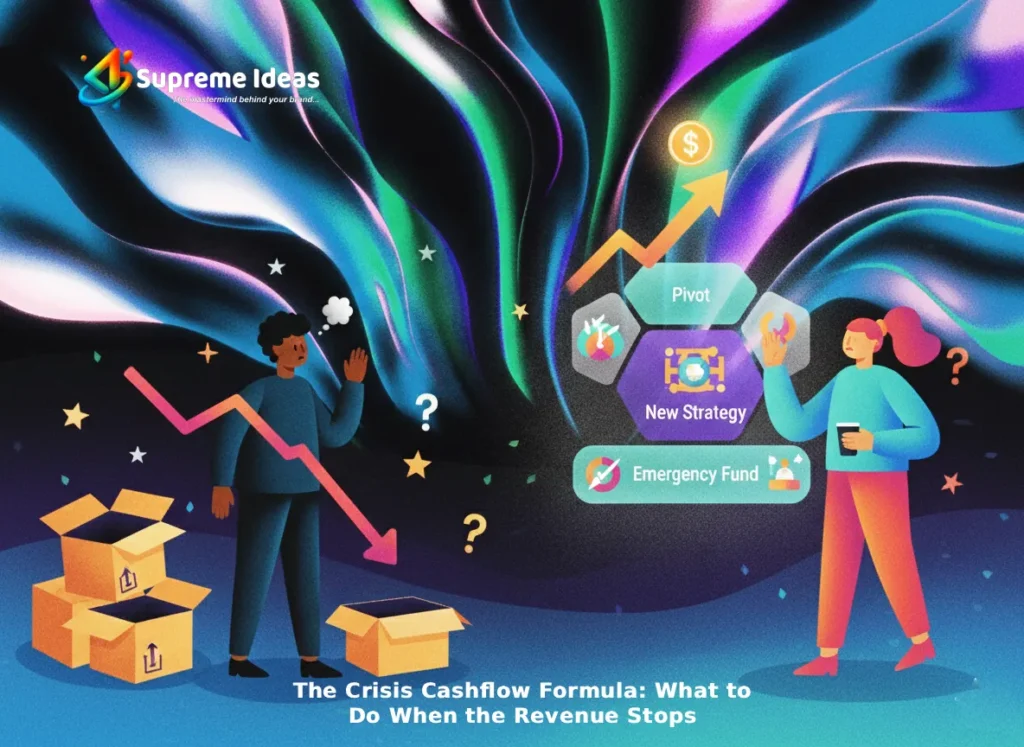
There is a specific kind of silence that happens when a business is dying.
it is not a loud explosion. it’s just the sudden, sickening absence of the Stripe notification sound on your phone. you wake up on a tuesday, check your dashboard, and the daily revenue line is completely flat. you think, “oh, it’s just a slow day.”
then wednesday is flat. then thursday your biggest client emails you to cancel their contract because they are having their own financial issues. then friday, your ad account gets inexplicably banned, shutting off your only lead source.
suddenly, you look at your bank balance. you look at your payroll spreadsheet. and you realize that in exactly fourteen days, you are going to run out of money. you will not be able to pay your team. you will not be able to pay your rent.
i mean—it’s intresting how fast your ego disappears when you realize you are two weeks away from public failure.
most founders completely freeze when this happens. they experience a trauma response. they stare at their monitors, paralyzed, hoping that some miracle whale client is going to drop out of the sky and save them. they try to “sell their way out of it” using the exact same slow, clunky sales process that got them into the mess in the first place.
you cannot rely on hope during a cash flow crisis. hope is not a financial strategy.
when the revenue stops, you must instantly transition into a wartime operator. you have to stop playing offense and start playing an aggressive, borderline ruthless game of financial defense and rapid liquidity extraction.
this is the Crisis Cashflow Formula. this is the exact, step-by-step operational playbook for what to do when your business is bleeding out and you have days, not months, to save it. we are going to look at how to artificially extract cash from your existing pipeline, how to squeeze your vendors, how to launch a “flash offer” that injects capital in 48 hours, and how to survive the psychological terror of the flatline.
if you execute this coldly and mathematically, you can save the company. if you sit there and panic… you are already dead.
The Paralysis of the Flatline: Understanding the Math of Survival
before you can execute the formula, you have to break out of your psychological paralysis.
when a crisis hits, the human brain tries to protect itself from pain by entering a state of denial. you tell yourself that next week will be better. you tell yourself that the big deal you pitched a month ago is “definitely going to close any day now.”
you have to kill this optimism. in a cash crisis, optimism is a liability. you must assume that zero new traditional revenue is coming in for the next 60 days.
Default Dead vs. Default Alive
Paul Graham introduced the concept of “Default Dead” or “Default Alive,” and it is the only math that matters right now.
you need to calculate your absolute, bare-minimum “survival burn rate.” this is not your current overhead. this is the overhead required to keep the server on and the core team eating ramen.
-
Take your current cash in the bank.
-
Subtract your survival burn rate.
-
How many weeks do you have left?
if that number is less than 8 weeks, you are Default Dead.
-
The Misconception: Founders beleive that a cash crisis is a revenue problem. “If i just close more sales, i’ll be fine.”
-
The Reality: A cash crisis is a time problem. Sales take time. In B2B, a sales cycle might be 45 days. If you only have 14 days of cash left, closing a deal today that pays you in 45 days does not save the company. You will still bounce payroll.
you do not need revenue right now. you need liquidity. liquidity is cash in hand today. the entire Crisis Cashflow Formula is designed to buy you time. if you can buy yourself 90 days of runway, you can fix the underlying revenue problem.
Step 1: The Accounts Receivable Liquidity Hack
the first rule of surviving a cash crunch is to look inside your own house before you look outside.
if you run an agency, a B2B service, or a consulting firm, you likely have tens of thousands of dollars sitting in Accounts Receivable (AR). this is money that clients legally owe you, but the invoice isn’t due for 30, 60, or 90 days.
when founders hit a crisis, they look at their AR spreadsheet and they just sigh, wishing the clients would pay early.
you do not wish. you engineer it.
The 20% Rescue Haircut
you are going to call every single client who owes you money. you are not going to email them. you are going to call them, because emails can be ignored.
you are going to offer them a massive, irrational discount in exchange for same-day wire transfers.
-
The Script: “Hi John. We are closing out our quarter a bit early and trying to clean up our books. You currently have a $10,000 invoice due in 45 days. I’m authorized to offer a one-time, 20% discount on that invoice if you can clear it via wire transfer by 5:00 PM today. That saves you $2,000 immediately. Does your accounting team want to take advantage of that?”
-
What most people misunderstand: Founders hate this idea. Their ego screams, “But i did $10,000 worth of work! If i take an $8,000 payment, i’m losing all my profit margin!”
yes, you are losing your profit margin. but you are gaining oxygen.
if you demand your profit margin and wait 45 days, your company goes bankrupt in 14 days, and you never collect the $10k anyway. if you take the 20% haircut, you get $8,000 of pure, liquid cash deposited into your account today.
in a crisis, you trade margin for speed. you are buying survival.
(no, really, i have used this exact tactic to pull $50,000 of locked-up cash into a bank account in 24 hours. corporate CFOs love immediate discounts. they will bend their own rules to save 20%).
Step 2: The “Flash Offer” Capital Injection
once you have swept your Accounts Receivable for every available dollar, you have to create new liquidity.
but remember the math of survival: you do not have time to run facebook ads, acquire cold leads, nurture them for three weeks, and close them. the customer acquisition cost (CAC) and the time delay will kill you.
you can only sell to people who already trust you.
Monetizing the Existing Base
your fastest path to cash is your current and past customer base. they already know who you are. they have already given you money. the friction to transaction is practically zero.
you are going to invent a “Flash Offer.” a flash offer is a highly specific, high-urgency, deeply discounted service or product that you offer exclusively to your internal list for a 48-hour window.
The Mechanics of a Good Flash Offer
a flash offer must obey three rules to work in a crisis:
-
It must require zero capital to fulfill. You cannot sell physical products that require you to buy inventory. You must sell digital assets, consulting time, or access.
-
It must solve an immediate pain. 3. It must be “Paid Paid Paid.” 100% of the cash must be collected at the moment of checkout. No payment plans. No invoicing.
-
Example for a SaaS Company: You look at your user base. You have 500 users paying $50 a month. You send an email: “We are raising capital for our next major feature rollout. For the next 48 hours, we are offering 50 ‘Lifetime Deal’ licenses. Pay $500 today, and never pay a monthly subscription fee again.”
if 20 people take that offer, you just injected $10,000 of liquid cash into your bank account in one afternoon. yes, you cannibalized a tiny bit of future recurring revenue, but you bought the company another month to live.
-
Example for a Service Agency: You run an SEO agency. The revenue stopped. You email your past clients (the ones who finished their contracts a year ago). “Hey guys, the Google algorithm just had a massive core update. We are doing 10 emergency ‘Algorithm Recovery Audits’ this weekend. It’s a 90-minute recorded teardown of your site to fix the leaks. Normally $1,500. For our alumni list, it’s $500 if booked by friday.”
you just invented a product out of thin air. it costs you nothing but your time to fulfill.
The Psychological Framing
when you launch a flash offer, you must not sound desperate. desperation repels money.
do not say: “We are struggling and need cash, please buy this.” say: “We are opening up a highly restricted beta program,” or “We are doing a private alumni sprint,” or “We are clearing our Q3 pipeline.”
you maintain high status while aggressively extracting liquidity from the market.
Step 3: The Vendor Squeeze (Holding Your Breath)
liquidity is a two-way street. it is the money coming in, minus the money going out.
while you are frantically pulling cash into the business through AR haircuts and flash offers, you must simultaneously build a dam to stop cash from leaving the business.
you have to squeeze your vendors.
Strategic vs. Non-Strategic Liabilities
look at your accounts payable. look at every single bill that is due in the next 30 days. you have to categorize them into two buckets.
Bucket 1: Strategic Liabilities (The Oxygen) these are the vendors who will literally shut your business down if you don’t pay them.
-
Amazon Web Services (AWS) or your server hosting.
-
Your core CRM.
-
The payroll of the essential employees who deliver your product.
you pay Bucket 1. you do not mess with Bucket 1.
Bucket 2: Non-Strategic Liabilities (The Fat) these are the vendors whose absence will cause pain, but will not kill the company.
-
Your PR agency.
-
Your fancy office landlord.
-
The software tool you use for social media scheduling.
-
The consultant you hired to help with “company culture.”
you freeze Bucket 2 immediately.
How to Renegotiate While Underwater
you do not just ignore their invoices. if you ignore them, they will send you to collections and hit your credit. you must control the narrative.
you pick up the phone and you call the landlord. you call the PR agency.
-
The Script: “Hi [Vendor Name]. I am calling to be completely transparent with you. Our business just hit an unexpected macroeconomic snag, and we are currently restructuring our cash flow to ensure we survive the quarter. Because of this, we are freezing all non-essential payables for the next 45 days. I cannot pay your invoice this week. I am committed to making you whole, but i need to stretch this payment out to a Net-90 timeline, or work out a payment plan starting next month.”
they will be angry. they will quote the contract. they will threaten late fees.
you hold the line.
-
The Follow-Up Script: “I completely understand your frustration, and you have every right to be upset. But the reality on the ground is that the cash simply isn’t in the account today. If you work with me on this extension, you will get paid. If you try to force a breach of contract, it will force us into insolvency and you will end up in a line of unsecured creditors getting pennies on the dollar. Let’s work together so you get your money.”
(yes I know that sounds dramatic—whatever, it’s the truth of how restructuring works).
most vendors will accept the delay, because they know that some money in 90 days is better than a lengthy legal battle with a broke startup.
by extending your payables by 60 days, you are artificially injecting cash into your business. you are holding your breath underwater until the flash offers and AR haircuts bring you back to the surface.
Step 4: The “Save the Furniture” Down-Sell
if your revenue stopped because a massive wave of clients just canceled their subscriptions or retainers (a churn crisis), you have to plug that specific hole before you bleed out.
when a client emails you to cancel, your default reaction is probably to argue with them, or to just say “okay, sorry to see you go,” and process the cancellation.
in a crisis, every single cancellation request must be treated as a negotiation.
The Psychology of the Churning Client
why do clients cancel? unless you did something horribly unethical, they usually cancel because their own budget got tight, or because they feel they aren’t using the service enough to justify the price.
they are trying to save cash. if you can help them save cash without entirely severing the relationship, you can retain a portion of the revenue.
The Maintenance Mode Down-Sell
when the cancellation email comes in, you immediately get on the phone with them.
-
The Script: “I received your cancellation request, and i completely understand. Before we process the offboarding, i want to offer an alternative. I know things are tight right now. Instead of completely shutting down your account and losing all the historical data and progress we’ve built, what if we put your account into ‘Maintenance Mode’?”
-
The Mechanics: “Maintenance Mode” means you strip away 80% of the deliverables and 80% of the price. If they were paying you $5,000 a month for full-service marketing, you drop them to $500 a month for basic hosting and one automated report.
-
Why it works: To the client, dropping from $5k to $500 feels like a massive win. They saved their budget, but they didn’t have to go through the painful friction of completely migrating away from your systems.
to you, retaining ten clients at $500 a month is $5,000 of pure, high-margin MRR. it keeps the lights on.
more importantly, when the client’s financial situation improves in six months, who are they going to go back to? the agency that is still holding their data in maintenance mode, or a brand new vendor? you saved the relationship.
Step 5: The Ruthless Burn Rate Recalibration
you have hacked your AR. you launched a flash offer. you squeezed the landlord. you down-sold the churning clients.
you have successfully bought yourself 60 days of oxygen. the flatline is over. the heart is beating again, but it is faint.
now, you have to ensure you never end up here again.
buying time is useless if you use that time to keep running the exact same broken business model. you must structurally alter the DNA of your company so that it can survive on the new, lower baseline of revenue.
The Delusion of the V-Shaped Recovery
the biggest mistake founders make after surviving a near-death cash crunch is assuming the revenue will just “bounce back” to normal next month.
they think, “okay, we survived June. July will be back to our $100k a month average.” no, it won’t.
if your revenue broke, the machine is fundamentally broken. you must assume that your new, lower revenue is permanent. if you dropped from $100k to $30k, you must rebuild the entire company to be wildly profitable at $30k.
if you keep your $100k overhead while hoping the revenue comes back, you will just hit another crisis in 60 days.
The Shift to Extreme Variable Costs
you have to surgically remove fixed costs. we discussed this in previous guides, but in the aftermath of a crisis, it is mandatory.
look at the team. if you have full-time salaried employees sitting around waiting for work that isn’t coming… you have to let them go.
it is agonizing. it is the worst day of a founder’s life. you will feel like a failure. but your fiduciary duty is to the survival of the entity. if you keep an inflated payroll out of guilt, you will eventually bounce checks, and everyone will be unemployed, and you will be sued.
fire the fixed payroll. transition to a variable model.
build a roster of elite freelancers and contractors. you pay them a higher hourly rate, but you only pay them when you have a signed client contract that requires their labor.
if revenue drops to zero next month, your labor costs drop to zero. the business becomes a cockroach. it becomes practically impossible to kill, because its burn rate shrinks to match its environment.
The Founder’s Salary Reality
and finally, you have to look in the mirror.
during a cash crisis, the founder eats last.
if you are taking a $10,000 a month salary while squeezing your vendors and laying off staff, you are a parasite on your own company.
you must cut your personal draw to the absolute minimum required to keep a roof over your head. you cancel your subscriptions. you stop eating out. you suffer alongside the P&L statement.
this does two things. first, it preserves the company’s precious cash. second, it forces you to feel the pain. when your personal lifestyle hurts because the business is failing, you will be highly motivated to fix the root cause of the failure, rather than just patching it with temporary hacks.
The Psychological Crucible: Managing the Panic
we have covered the math, the scripts, and the operational tactics. but none of this matters if your brain breaks.
a revenue flatline is a uniquely terrifying psychological event. it attacks your identity. if you built a successful company, you probably tied your self-worth to that Stripe dashboard. when the dashboard goes to zero, you feel like you are a zero.
The Isolation Trap
the first instinct of a failing founder is to hide.
you don’t want to tell your spouse because you don’t want them to panic. you don’t want to tell your team because you fear they will quit. you don’t want to tell your founder friends because you are embarrassed that you aren’t “crushing it.”
so you sit in your office alone, carrying the weight of impending bankruptcy in absolute silence.
this isolation breeds terrible decision-making. when you are alone with your panic, you will make short-term, destructive choices. you will take out a predatory merchant cash advance loan at 40% interest. you will lash out at a good client.
Breaking the Silence
you must break the isolation immediately.
you need a “Wartime Consigliere.” this is a mentor, an advisor, or another founder who has actually been through the fire. you do not talk to a 22-year-old life coach. you find someone who has survived a near-bankruptcy.
you get on the phone with them and you lay out the brutal truth. “My revenue stopped. I have $14k in the bank. My payroll is $12k. I am terrified.”
the simple act of saying the numbers out loud to someone who understands the game removes 50% of the panic. it moves the problem from the emotional center of your brain (the amygdala) to the logical, problem-solving center (the prefrontal cortex).
the mentor will look at your numbers without the emotional attachment and say, “Okay, this is bad, but it’s not fatal. Fire the PR firm today, call these three clients for an AR discount, and launch a flash sale by friday. You’ll survive.”
The Power of Motion
panic paralyzes. the antidote to paralysis is aggressive, micro-level motion.
when you don’t know how to solve the massive, existential problem of “saving the company,” you do not try to solve it all at once. you break it down into atomic actions.
you don’t write “Save the business” on your to-do list. you write: “Draft the AR discount email.” then you write: “Call the landlord.” then you write: “Outline the flash offer.”
you just focus on executing the next 15-minute task. you keep your head down. you execute the Crisis Cashflow Formula step by step. you let the compounding effect of those atomic actions rebuild the liquidity of the company.
Conclusion: The Gift of the Fire
if you are reading this because your revenue has stopped, and you are staring down the barrel of a cash flow crisis, i need you to understand one fundamental truth.
this crisis is the best thing that could possibly happen to you.
i know it feels like death right now. but businesses that never experience a near-death crisis are soft. they are bloated. they are arrogant. they operate on the delusion that the good times will last forever, and when a real macroeconomic shift happens, they get wiped off the face of the earth.
when you go through a revenue flatline and you survive it… you are forged in fire.
you learn exactly what your business is made of. you find out which team members will fight for you in the trenches, and which ones will run at the first sign of trouble. you realize that 40% of the expenses you thought were “essential” were actually just ego-driven garbage.
you strip the company down to the studs. you build the AR collection habits, you transition to variable costs, and you learn how to inject capital on demand using flash offers.
the company that emerges on the other side of this crisis will be a hardened, lean, hyper-profitable machine.
the terror you feel right now is the tuition you pay to become a master operator.
do not let the terror paralyze you. the math can be fixed. the vendors can be negotiated. the cash can be extracted.
stop staring at the dashboard. pick up the phone. go get your money.
…anyway, the clock is ticking. start with the Accounts Receivable.
Category: Financial, Legal & Exit | Survival & Crisis Management