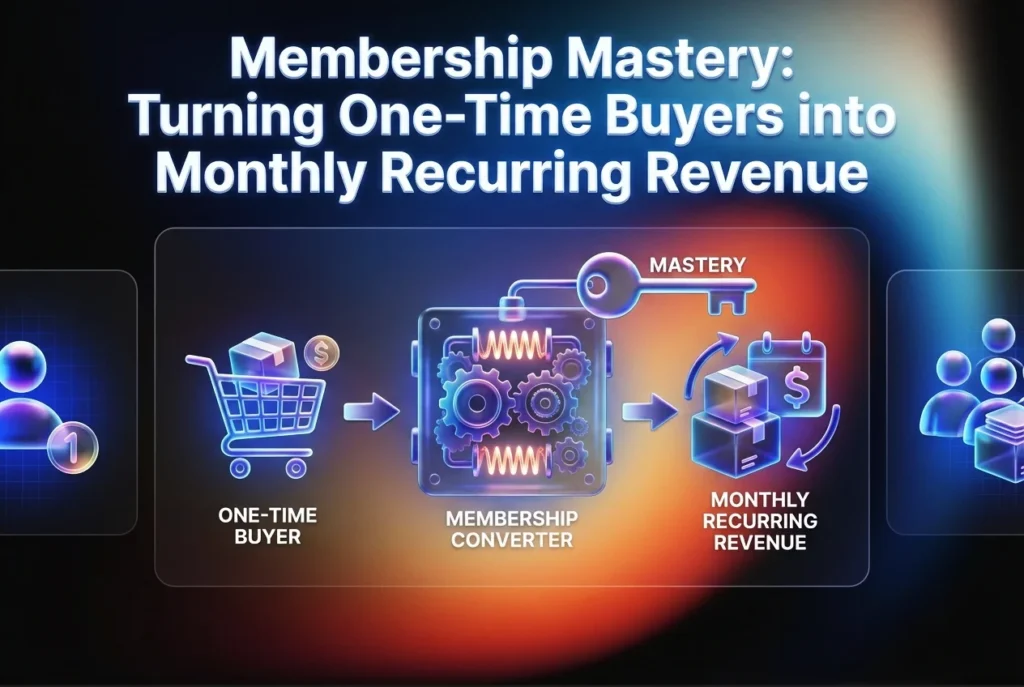
There is a very specific, quiet kind of nightmare that service providers, course creators, and e-commerce founders live in. it is the nightmare of the first of the month.
you spend thirty days hustling. you run the ads, you take the sales calls, you pitch your heart out. you close $30,000 in one-time sales. you feel like an absolute god. you buy an expensive dinner to celebrate.
and then the calendar flips. you wake up on the 1st of the new month, you look at your dashboard, and your revenue is exactly zero. your overhead is still there. your payroll is still due. but the cash you made last month is gone, and you have to start the entire grueling process all over again.
you don’t own a business. you own a hunting license.
you are an apex predator, sure. but if you don’t kill something today, you don’t eat tomorrow. this is the “eat what you kill” business model, and it is the single fastest path to founder burnout. it is the reason you can never take a real vacation, and it is the reason your company has virtually zero valuation if you ever try to sell it. (buyers do not buy hunting licenses. they buy farms).
to build an actual, sellable asset—and to buy back your own sanity—you have to transition from a hunter to a farmer. you have to build a system where the harvest happens automatically, every single month, whether you get out of bed or not.
you have to master the psychology and the mechanics of Monthly Recurring Revenue (MRR).
this is the definitive, brutal guide to turning your one-time buyers into lifelong, monthly subscribers. we are going to tear down the exact scripts to transition a past client into a retainer. we will look at the massive psychological mistake of the “content trap” that kills most membership sites, and we will break down the mathematical architecture of the three primary recurring revenue models.
if you do not build a recurring backend to your one-time frontend, you are leaving 80% of your customer’s lifetime value on the table, and you are choosing to play the game on hard mode forever.
The Psychology of the Subscription: Why People Actually Stay
before you can build a membership, you have to understand why human beings actually allow their credit cards to be charged every thirty days.
most founders get this completely wrong. they beleive that people subscribe to get “more stuff.” they think, “if i just give them four new videos a month, a weekly newsletter, and a monthly Q&A call, the volume of stuff will justify the $99 a month.”
this is the fastest way to churn your entire user base.
people do not want more stuff. people are already drowning in stuff. they are drowning in unread emails, unwatched youtube tutorials, and un-implemented advice.
The “Gym Membership Guilt” Effect
when you sell a membership based purely on the volume of content, you accidentally trigger a psychological phenomenon i call Gym Membership Guilt.
think about why people cancel their gym memberships. they don’t cancel because the gym took away the treadmills. they cancel because they haven’t gone to the gym in three weeks. every time they see that $50 charge on their bank statement, it acts as a painful, recurring reminder of their own failure and indiscipline. they cancel the membership just to make the guilt stop.
when you fill your membership site with 500 hours of video content, your customer logs in, looks at the massive mountain of work you just assigned them, and they feel overwhelmed. they don’t watch the videos. next month, they get charged. they feel guilty. they cancel.
-
The Misunderstanding: Founders think volume equals value. “I am giving them so much content for just $99!”
-
The Reality: Volume equals overwhelm. Overwhelm equals guilt. Guilt equals churn.
The Three True Drivers of Recurring Revenue
if they don’t stay for the content, what do they stay for? they stay for one of three things.
1. The Ongoing Transformation (The Path) people don’t buy a subscription to learn; they buy a subscription to change. if your one-time product is a $1,000 course on how to start a diet, the membership is the $49/month accountability group that actually keeps them on the diet. the one-off product provides the map. the recurring product provides the vehicle to travel the map.
2. The Identity and Status (The Tribe) human beings are desperately lonely and crave status. if you build a high-ticket mastermind ($1,000+ a month), people do not pay that to watch your videos. they pay it to be in a slack channel with 50 other high-net-worth founders. they are paying for access to a peer group that elevates their own social and professional status. if they cancel the membership, they lose the tribe. losing a tribe is evolutionary suicide, so they never cancel.
3. The Friction Removal (The Utility) this is the B2B goldmine. people will pay you forever if you just make an annoying problem disappear. if you sell a one-time $5,000 website build, the client is thrilled. but then they realize they have to update the plugins, host it, and fix it when it crashes. the recurring product is a $500/month “peace of mind” retainer where you handle everything. they are paying to not have to think about it.
if your membership does not fit into one of these three categories, it is a fragile gimmick that will crumble the second the economy gets tight.
The Transition: Bridging the Gap from One-Off to Recurring
so you have a one-time product. a consulting package, a physical widget, or an informational course. how do you actually convince the person who just bought it to immediately start paying you every month?
you use the Ascension Model.
the ascension model is a deeply choreographed sales sequence that bridges the gap between the initial dopamine hit of the first purchase and the reality of long-term implementation.
The “What Happens Next?” Pitch
the absolute worst time to pitch a membership is a month after they bought the initial product. by then, they have forgotten about you. the dopamine is gone.
the best time to pitch the recurring offer is the exact second you finish delivering the one-time offer.
let’s look at how this works in a service business. you run an agency. you just finished a massive, three-month branding and logo design project for a client. you handed over the final assets. the client loves it.
-
The Bad Approach: “Here are the files! Thanks for your business. Let me know if you ever need anything else.” (The client takes the files, leaves, and you are back at zero).
-
The Good Approach: You schedule a mandatory 30-minute “Offboarding and Implementation” call. You hand over the files. You let them tell you how happy they are. And then, you pivot.
-
The Script: “I am so glad you love the new brand identity. It looks incredible. Now, here is what is going to happen next. You are going to take these assets to your marketing team, and they are going to struggle to implement them correctly. They are going to stretch the logo, use the wrong hex codes, and the brand will get diluted over the next six months. It happens every time. Instead of letting that happen, we have a Brand Guardian retainer. For $1,500 a month, my team becomes your fractional design department. Anytime you need a social post, a pitch deck, or a billboard designed using this new branding, you just slack us and we do it within 48 hours. No hourly billing, no quoting, just infinite brand protection. Do you want us to just roll right into that starting monday?”
do you see the mechanics there? you predicted their future pain. you agitated the fact that the $10,000 they just spent on the brand is going to be wasted if they don’t maintain it. and then you offered a frictionless, utility-based solution.
(no, really, i have used this exact script to turn 60% of one-off projects into multi-year retainers. it works because it is entirely logical).
The E-commerce “Subscribe & Save” Trap
if you sell physical products (supplements, coffee, skincare), the transition is different. you use the “Subscribe & Save” model.
but most e-commerce brands execute this terribly. they put a tiny checkbox on the checkout page that says “save 10% if you subscribe.” the customer ignores it because they haven’t even tasted the coffee yet. why would they commit to a lifetime of it?
-
The Fix: You don’t pitch the subscription on the first purchase. You let them buy the single bag of coffee. You wait exactly 21 days (or whatever the lifecycle of your product is). Right when they are hitting the bottom of the bag, you trigger an automated email sequence.
“Hey, you are probably running out of the Ethiopian roast right about now. Going to the store tomorrow morning and realizing you are out of coffee is the worst way to start a tuesday. Click here to put it on autopilot. We will ship it today, give you 15% off forever, and throw in a free travel mug with your first recurring order.”
you trigger the transition precisely at the moment of depletion.
The Three Core Architectures of Recurring Revenue
not all memberships are created equal. the architecture you choose will dictate your profit margins, your required time investment, and your churn rate.
you must pick the model that aligns with your operational bandwidth.
Model 1: The Productized Service Retainer (High Margin, High Labor)
this is for agencies, freelancers, and consultants. you stop selling hours and you start selling “access and output.”
instead of saying “we charge $150 an hour for graphic design,” you say “we charge $2,000 a month for unlimited graphic design requests, delivered one at a time.”
-
The Economics: In month one, the client might abuse the system and ask for a ton of designs. Your margin is low. But by month three, the client gets busy with their own business. They might only ask for two graphics the entire month. You still collect the $2,000. Your profit margin expands exponentially as the client’s utilization drops.
-
The Moat: The churn on productized services is incredibly low because you have integrated yourself into their daily operations. To fire you, they would have to go out and hire a full-time employee for $60,000 a year. You are the cheaper, faster, more reliable alternative.
Model 2: The “Done-With-You” Coaching/Community (High Margin, Medium Labor)
this is the evolution of the online course. you sell a core curriculum, but the recurring revenue comes from the ongoing access to you and the community of peers.
-
The Economics: You charge $200 a month. You put 500 people in a Skool or Discord group. You do one live group Q&A call a week. Your gross margin is 95%. It is basically pure profit.
-
The Moat: The founder is usually the bottleneck here. If the community relies entirely on your personal charisma to survive, you can never take a week off. You must engineer the community so the members start answering each other’s questions. You have to hire “community managers” from within your own ranks to foster engagement. If the community becomes self-sustaining, it is an unbreakable asset.
Model 3: The Software/Utility Model (Low Initial Margin, Lowest Churn)
this is the classic SaaS (Software as a Service) play, but it doesn’t have to be complex code. it can be a paid newsletter, a curated database, or a template library.
-
The Economics: You charge $49 a month. The cost to deliver the software or the database to one person is the exact same as delivering it to ten thousand people.
-
The Moat: Utility. If you build a database of highly vetted real estate leads, and you update it weekly, real estate agents will pay you $49 a month until they die. Why? Because the ROI is mathematical. If your $49 tool makes them one $10,000 commission a year, canceling your tool is financially irrational.
if you want to build a truly massive company, you aim for Model 3. you divorce your time entirely from the fulfillment of the recurring value.
The Onboarding Window: Securing the First 30 Days
we talked about this in the churn guide, but it is so critical for memberships that we must expand on it here.
when someone upgrades from a one-time buyer to a monthly subscriber, they experience immediate buyer’s remorse. they look at their credit card and think, “did i really just commit to paying this guy every month? i already have too many subscriptions.”
you have exactly 14 days to prove that your subscription is the only one they actually need.
Engineering the Immediate Win
if they log into your membership portal and are greeted with a “Welcome” video that says, “Take the next three weeks to explore the library!”… they will churn before the next billing cycle.
you must engineer an immediate, undeniable, hyper-specific win within 72 hours.
-
The Bad Approach: Giving them a 40-page PDF on “how to optimize their business.”
-
The Good Approach: “Welcome to the group. Do not look at the course library yet. Your only homework for the next 48 hours is to copy and paste this exact email script to your past clients. Post a screenshot in the slack channel when you get your first reply.”
they send the email. they get a client to reply. they make $1,000.
they just paid for a year of your membership in the first three days. their logical brain takes over and says, “well, i can never cancel this subscription now, it literally makes me money.”
The Concierge Welcome (Breaking the Digital Wall)
if you charge anything over $99 a month, automation is not enough for onboarding. you must break the digital wall and prove there are humans behind the screen.
when a new member joins, they should receive a personalized, 60-second Loom video from you or your community manager.
“Hey Sarah, saw you just upgraded to the inner circle. We were looking at the website you submitted, and the team actually has a couple of quick ideas on how to fix that hero headline. Drop a message in the #introductions channel today and tag me, and i’ll send those over.”
it takes you 60 seconds to record. but to the buyer, it is mind-blowing. they realize they didn’t just buy a login credential; they bought a relationship. people cancel logins effortlessly. people hate canceling relationships.
Battling Subscription Fatigue (The “ROI Positive” Positioning)
we have to address the macroeconomic reality. consumers are exhausted by subscriptions.
they have Netflix, Spotify, Amazon Prime, a gym membership, three software tools, and a meal delivery kit. their bank statement is a graveyard of $15 charges.
when you try to pitch another subscription, their default instinct is to aggressively defend their remaining cash flow.
you cannot win by pretending to be “just another cool subscription.” you have to position your membership as the exact opposite of an expense.
The Cost-Replacement Strategy
the most effective way to sell a membership is to prove that buying your membership actually lowers their monthly overhead.
you are not an additional cost; you are a cost-replacement mechanism.
-
Scenario: You are selling a $299/month membership for e-commerce founders that gives them access to top-tier ad templates, direct Q&A with media buyers, and landing page wireframes.
-
The Pitch: “Right now, you are probably paying an entry-level media buyer $4,000 a month to guess at your ad strategy, and you are paying a web designer $1,000 a month to build pages that don’t convert. Fire them. For $299 a month, you get the exact plug-and-play assets and the strategic direction that a $15k/month agency would give you. You aren’t spending $299. You are saving $4,700.”
when you frame it as a replacement of an existing, more expensive, more frustrating liability… the membership becomes a no-brainer.
The “Cancel Anytime” Psychology
founders are terrified of making it easy to cancel. they hide the cancellation button behind four sub-menus and a mandatory phone call (i know i recommended the mandatory phone call for high-ticket B2B, but for consumer memberships, it’s a different game).
if you make it hard to cancel, you create a hostage situation.
-
The Reality Check: If you explicitly tell them during the sales pitch, “There are no contracts. You can cancel with one click inside your dashboard, no questions asked, anytime you want”… you will actually increase your conversion rate by 20%.
you remove the fear of the trap. they think, “well, i’ll just try it for a month, and if it sucks, i’ll click the button.”
once they are inside, if your onboarding is flawless and your value is high, they won’t click the button. you lowered the drawbridge to get them into the castle, and then you made the castle so incredible they never wanted to leave.
The Toxic Churn Cycle: When to Kill Your Own Membership
i have to include a warning label here, because i have seen founders destroy their mental health trying to keep a dying membership site alive.
not every business should have a membership. if you force a recurring model onto a product that doesn’t actually require ongoing support, you will enter the Toxic Churn Cycle.
this happens when you launch the membership, 100 people join, and you feel great. but you don’t actually have a recurring solution; you just stretched a one-time course over 12 months.
by month three, the members realize they have consumed all the value. they start churning at 15% a month.
you panic. you start scrambling to create “new content” every single week just to justify the recurring charge. you are running on a hamster wheel, recording videos nobody watches, just to stop the bleeding.
the stress of creating content for a dying membership will kill your ability to grow the core business.
The Autopsy of a Dying Group
if your churn rate on a low-ticket membership stays consistently above 10% for three months, the model is broken.
do not try to “add more content.” do not lower the price.
you have two choices:
-
The Hard Pivot: You realize it’s an identity problem. You stop selling the content, and you start heavily facilitating the community. You host live events. You do hot-seats. You transition from a library to a mastermind.
-
The Execution: You kill it. You email the remaining members, you say “we are sunsetting the recurring model and transitioning this to a one-time lifetime access product.” You refund their last month, you package the content as a standalone $500 course, and you go back to what you are good at.
there is no shame in killing a bad membership. keeping it alive out of pure ego is what bankrupts you.
Addressing Common Objections and FAQs
when founders map out this transition, their insecurities always flare up around these specific points.
“I don’t have enough stuff to give them every month! What if i run out of ideas?” i mean—it’s intresting how pervasive this fear is. it goes back to the content trap. you do not need new ideas every month. the best memberships in the world say the exact same core truths every single month, just applied to different situational contexts. a fitness coach doesn’t invent a new way to lift weights every month; they just hold the client accountable to the basics. your members are paying for your filter, your curation, and your accountability, not your endless novelty.
“Won’t they just join for one month, download all my proprietary templates, and then cancel?” yes. some of them will. the “dine and dash” is a reality of digital business. but remember the rule of scammers: you do not build your business around the 1% of sociopaths. you build it around the 99% of honest people who value your time. if someone steals your templates and leaves, they lack the strategic context to actually execute them properly anyway. let them go. the people who stay are the ones who understand that the templates are useless without your ongoing guidance.
“I’m an e-commerce brand. Aside from subscribe-and-save, how do i do this?” you build a VIP access model. look at Amazon Prime or Restoration Hardware. people pay a flat annual or monthly fee simply for the privilege of getting free shipping, early access to new product drops, or exclusive colorways. you aren’t selling a recurring physical product; you are selling a recurring status and utility layer that wraps around the physical product.
The Reflective Conclusion: The Peace of the First of the Month
we started this guide talking about the nightmare of waking up at zero on the first of the month.
i want to end by describing what the other side of the mountain looks like.
when you execute the membership model correctly, when you engineer the TTV, fire the toxic clients, and build a recurring revenue baseline that covers 100% of your operating expenses… the psychology of the founder fundamentally alters.
you wake up on the 1st of the month, and you look at your dashboard.
before you have even had your coffee, before you have sent a single email, the system has automatically processed your recurring charges. your payroll is covered. your rent is covered. your software bills are paid.
you are no longer operating from a place of survival. you are operating from a place of absolute surplus.
when you don’t need to close a deal to survive, your sales calls change. you become deeply relaxed. you become willing to tell a bad prospect “no.” and paradoxically, because you are no longer desperate, your close rate skyrockets. prospects can smell the lack of neediness, and it makes them want to buy from you even more.
turning one-time buyers into recurring revenue isn’t just a clever financial hack to increase your lifetime customer value.
it is the structural foundation of your personal freedom.
it allows you to stop hunting every single day, and gives you the breathing room to actually sit back, look at the horizon, and decide what kind of empire you actually want to build.
…anyway, go look at the project you just finished delivering yesterday. pick up the phone. offer them the “What Happens Next” retainer. you have nothing to lose but a one-time transaction.