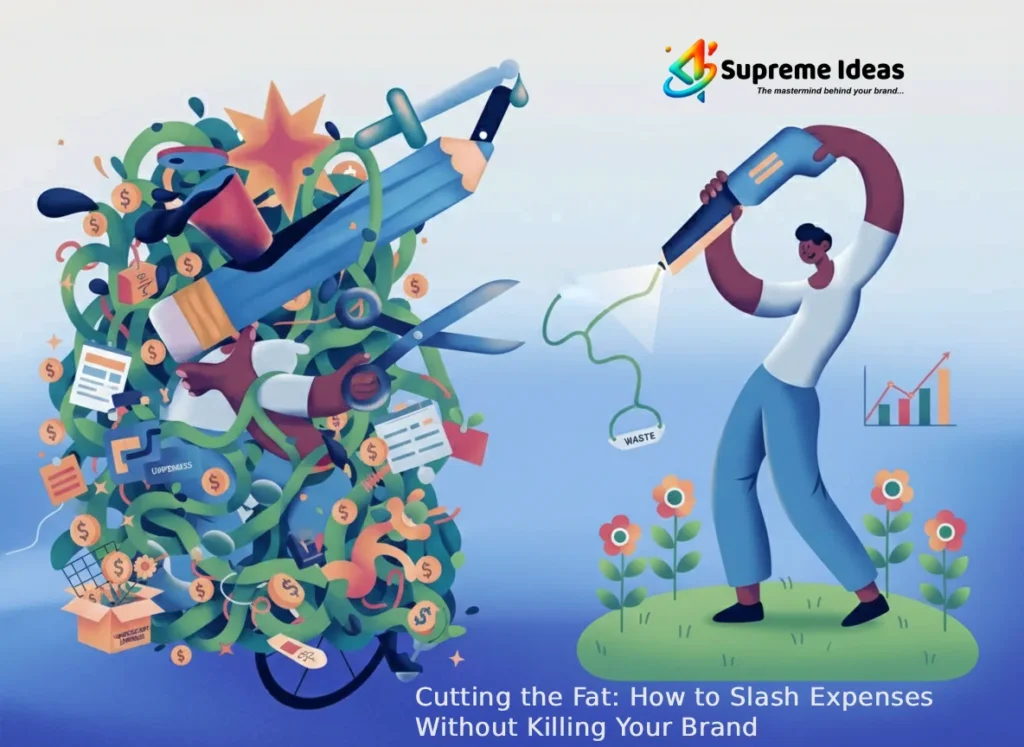
There is a specific type of cold sweat that hits a founder when they look at their P&L statement during a bad month. revenue dips, the market gets weird, a major client churns, and suddenly that comfortable buffer of cash you thought you had looks incredibly thin.
when this happens, the default human response is panic. the founder goes into a frenzy, grabbing a metaphorical machete and hacking away at every line item on the spreadsheet. they fire the receptionist, they cancel the marketing software, they downgrade the packaging materials, and they switch the office coffee to that terrible powdered stuff.
they look at the newly slashed budget, wipe the sweat off their forehead, and think they saved the company.
they didn’t save the company. they just gave it a slow-acting poison.
this is the grand delusion of cost-cutting. most founders do not know the difference between fat, muscle, and bone. fat is bloat—it’s the ego-driven expenses, the unused software, the inefficient processes. muscle is your revenue-generating capacity—your sales team, your lead gen, your core operational efficiency. bone is your brand—the foundational trust, quality, and reputation that keeps people coming back.
when you hack blindly at a budget, you almost always cut muscle and bone because they are usually the most expensive line items. you save ten thousand dollars today, but you destroy a hundred thousand dollars of brand equity and future revenue over the next twelve months.
this is a complete guide to surgical cost reduction. we are going to look at how to strip your business down to the studs, eliminate the invisible bloat that is quietly eating your margin, and—most importantly—how to do it without your customers ever feeling a drop in quality.
if you do this right, your business won’t just survive a downturn. it will come out the other side leaner, faster, and wildly more profitable.
The Panic Purge vs. The Surgical Strike
to slash expenses effectively, we first have to fix your mindset. cost-cutting should never be an emotional reaction to a bad quarter. if you are cutting costs while you are panicked, you are going to make incredibly stupid decisions. (no, really, i have seen founders fire their best closer to save a $100k salary, only to watch $1M in pipeline revenue vanish the next month. it’s tragic).
the Panic Purge is reactive. it looks at the largest numbers on the spreadsheet and tries to make them smaller.
the Surgical Strike is proactive. it ignores the size of the number and looks entirely at the Return on Investment (ROI) of that specific line item.
Zero-Based Budgeting for Startups
most businesses operate on historical budgeting. “we spent $5k on marketing software last year, so we’ll budget $5k for it this year.”
if you want to cut the fat, you have to adopt Zero-Based Budgeting. you pretend your business was founded this morning. your budget is exactly zero. every single expense—from the $10,000 retainer for your PR agency down to the $15 monthly Canva subscription—must justify its own existence to be added back into the budget.
-
The Bad Approach: Looking at your $50,000 monthly overhead and saying, “I need to cut this by 20% across the board.” You force every department to operate with 20% less resources, which guarantees a 20% drop in overall quality.
-
The Good Approach: Looking at your $50,000 overhead, resetting it to zero, and building it back up brick by brick. You might realize that one department needs a 10% increase in budget because they generate all your profit, while another department can be entirely eliminated.
you do not cut across the board. you cut the dead branches completely so the healthy branches can get more sunlight.
The “Playing Office” Tax: Slaying the Ego Expenses
let’s start with the easiest fat to cut. this is the fat that founders accumulate when they are trying to prove to the world that they run a “real” business.
we watch movies about Silicon Valley, and we see the massive headquarters, the catered lunches, the custom Patagonia vests, and the PR teams. we internalize this. we beleive that to be successful, we have to look successful.
i call this the “Playing Office” Tax. it is the premium you pay to stroke your own ego.
Office Space and Geography
the most obvious ego tax is commercial real estate. if you run a digital agency, a SaaS company, or a consulting firm, and you are leasing a Class A office space in a downtown metro area just so you can have a cool backdrop for your Zoom calls… you are burning cash.
clients do not care about your exposed brick wall. they do not care about your cold brew on tap. they care if you can solve their problem.
-
The Reality Check: Ask yourself, “If i gave up this office tomorrow and went fully remote, would my product get worse?” If the answer is no, that lease is pure fat.
-
The Nuance: What if your team hates remote work and needs collaboration? Downgrade to a functional coworking space. You do not need your name on the building. You need a room with a whiteboard and strong WiFi.
The PR and “Awareness” Retainers
i see so many early-stage founders paying $5k to $10k a month to PR agencies to get them quoted in Forbes or Business Insider. they think this is “building the brand.”
it is intresting how quickly vanity metrics can disguise themselves as marketing. if you are an enterprise software company, getting a quote in a generic business magazine does not drive SQLs (Sales Qualified Leads). it just gives you something to send to your mom.
if an expense is designed to make you famous rather than make you profitable, cut it immediately. brand is built through exceptional delivery and targeted authority, not through bought media placements that nobody reads.
The SaaS Graveyard: Auditing Subscription Bloat
this is where the silent bleeding happens. in the modern business world, software is so cheap and accessible that we just subscribe to everything. “it’s only $29 a month,” we say.
then you wake up three years later and you are spending $4,000 a month on software.
the SaaS Graveyard is filled with tools you bought to solve a temporary problem, tools that overlap with other tools, and tools that your team requested but abandoned after two weeks.
How to Run the SaaS Audit
you cannot do this by asking your team what software they use. they will say they use all of it, because humans hate giving up resources.
-
Pull the Credit Card Statements: Export the last 90 days of transactions into a spreadsheet. Filter for recurring charges.
-
The Overlap Check: Look at the functions. Do you have Asana, Trello, and Monday.com? Why? Pick one project manager and kill the others. Do you have Zoom, Google Workspace (which includes Meet), and a paid Slack plan (which includes huddles)? You are paying for video conferencing three times.
-
The Usage Check: Log into the admin panel of the expensive tools. Look at the last login dates for your seats. You will likely find that half the “Pro” seats you are paying for haven’t been logged into in 60 days. Downgrade them to free tiers or remove the users.
The Cost of Complexity
there is a hidden benefit to slashing your software stack that goes far beyond the monthly savings.
every time you add a piece of software, you add operational complexity. your team has to remember where data lives. they have to integrate the APIs. they have to switch contexts between tabs.
when you cut the fat out of your tech stack, you force your team to simplify their workflows. a team running purely on Google Docs, a simple CRM, and Slack will often outmaneuver a team bogged down by fifteen different “productivity” tools. fewer tools mean less context switching, which means higher actual productivity.
The Rule of Revenue Proximity: Evaluating Your Team
this is the hardest section to write, and it is the hardest part of being a founder. evaluating personnel costs.
when revenue drops and you realize you are overstaffed, the panic sets in. the worst thing you can do is fire people based on who makes the highest salary. the highest salary might be the only person keeping the company afloat.
you must evaluate your team based on the Rule of Revenue Proximity.
how close is this person’s daily output to a client paying an invoice, or a client deciding to stay for another year?
Zone 1: The Revenue Drivers (The Muscle)
these are your closers. your lead generation specialists. your core product engineers who build the features that people actually buy.
these people are standing right next to the cash register. if you fire a revenue driver to save $8,000 a month, you might inadvertently choke off $50,000 a month in new top-line revenue. you do not cut the muscle. you protect the muscle at all costs.
Zone 2: The Retention Drivers (The Bone)
these are your account managers. your customer success team. your quality assurance people.
they don’t bring in new money, but they protect the money you already have. they are the guardians of your brand equity.
-
The Misconception: Founders often look at customer success as an “expense” center because they don’t generate direct sales. So they cut the account managers, forcing the sales team to handle client support.
-
The Reality: The sales team stops selling because they are busy answering support tickets. The clients get pissed off because the support is terrible. Churn spikes. You saved $5k on a salary and lost $30k in MRR.
you do not cut the bone. if you destroy your delivery, your brand dies.
Zone 3: The Organizational Bloat (The Fat)
this is where the cuts must happen. these are the roles that are three or four steps removed from the revenue.
it is the middle management that exists only to manage other managers. it is the “strategy consultants” who create beautiful slide decks that nobody implements. it is the excessive administrative staff that you hired because you didn’t want to build automated SOPs.
-
The Reality Check: Look at a role and ask: “If this person did not show up to work for three weeks, would a client notice? Would a deal be lost?”
if the answer is no, that role is organizational fat. it might be convenient to have them around, but convenience is a luxury you cannot afford when you are optimizing for margin.
Fractional Replacements
when you do have to cut a full-time role, you rarely have to lose the function entirely. we live in the golden age of fractional talent.
if you realize your full-time CFO or full-time CMO is eating your margin, but you still need financial oversight and marketing direction… you transition to a fractional executive. you pay $3k a month for high-level strategy and oversight, rather than $15k a month for them to sit in an office and pretend to be busy 40 hours a week.
you buy the expertise, not the hours.
Protecting the Brand: What You Can NEVER Cut
this is the crux of the entire strategy. how do you slash all this expense without the market looking at your business and thinking, “wow, they really went downhill”?
your brand is not your logo. your brand is the sequence of experiences a customer has with your company. it is the trust gap between what you promised and what you delivered.
if you cut expenses in a way that widens the trust gap, you are killing your brand.
The Core Deliverable is Sacred
you can change your office. you can use cheaper software. you can fire your PR team. but the actual thing the client is paying for must remain flawless.
-
Example (Physical Product): If you sell a premium skincare line, you can negotiate cheaper shipping rates, you can move out of your expensive warehouse and use a 3PL, and you can cut your Facebook ad budget. But you absolutely cannot switch to a cheaper, lower-quality chemical in the serum. The moment the product burns someone’s face, your brand is dead.
-
Example (Service Business): If you run a high-ticket consulting firm, you can stop flying first class to client meetings. You can switch to Zoom. But you cannot outsource the actual consulting calls to a cheap offshore team who doesn’t understand the client’s business. The expertise is the sacred deliverable.
The Onboarding Experience
this is the most critical psychological touchpoint in the customer journey. the first 14 days after someone hands you money is when they suffer from buyer’s remorse.
if you slash your budget by firing your onboarding specialist and replacing them with a clunky, automated PDF… the client is going to feel abandoned. they will instantly regret their purchase.
you must over-invest in the first impression. send the handwritten note. make the personalized welcome video. have a human being walk them through the setup. these things cost very little in hard dollars but require high operational bandwidth. whatever you cut, do not cut the budget that makes a new customer feel safe.
The Speed of Resolution
when things go wrong, how fast do you fix it?
if you cut your customer support team so drastically that your response time goes from 2 hours to 48 hours, you are destroying your brand. people will forgive a bug. they will forgive a delayed shipment. they will never forgive being ignored.
if you have to cut support staff, you must simultaneously invest in extreme self-service infrastructure. build a flawless knowledge base. use AI to handle the tier-1 repetitive questions instantly. but you must ensure that when a client is in actual pain, a human being can reach them quickly.
The Vendor Squeeze: Renegotiating Without Burning Bridges
one of the most effective ways to slash expenses without touching your team or your product is to look at the money flowing out to third-party vendors.
most founders sign a contract with a supplier, a software provider, or a landlord, and then they never look at it again. they just let the auto-pay run for years.
everything is negotiable. especially in a volatile economy. your vendors want to keep your business just as badly as you want to keep your clients.
How to Ask for Discounts (The Right Way)
you do not call your vendor and say, “we are running out of money and need a discount.” that signals that you are a flight risk, and they might actually drop you to cut their own losses.
you approach the negotiation from a position of strategic partnership.
-
The Script: “Hi [Vendor], we are doing a comprehensive audit of all our operational expenses for the upcoming year to optimize our margins. We love working with you and want to keep you as our primary provider, but we have received a few competitive bids that are coming in about 20% lower than our current rate. Given our history, is there any flexibility in our current pricing or terms to help close that gap so we don’t have to switch?”
you are not begging. you are presenting a business reality. you are giving them the opportunity to keep your revenue.
often, they will not be able to drop the price by 20%. but they might drop it by 10%. or, more importantly, they might offer you better terms.
The Power of Payment Terms
if a vendor cannot lower their price, negotiate the cash flow.
if you currently pay a supplier Net-30 (you pay 30 days after the invoice), ask for Net-60 or Net-90.
why does this matter? because cash flow is oxygen. if you can hold onto your cash for an extra 60 days before paying your vendor, you can use that cash to fund your own marketing, payroll, or product development. extending your payables without extending your receivables is one of the most powerful ways to artificially boost your operational cash without technically “cutting” a hard expense.
The Invisible Fat: Slashing Operational Inefficiency
so far, we have talked about cutting things that show up on a credit card statement. but the thickest, most dangerous fat in your business doesn’t have an invoice.
it is the invisible fat of operational inefficiency. time is money, and most companies waste an astronomical amount of time.
The Meeting Plague
i want you to look at your calendar, and the calendars of your core team. how many hours are spent in recurring internal status meetings?
let’s do the math. if you have a weekly one-hour “all hands” meeting with 10 people, and the average hourly rate of those people is $50… that meeting costs the company $500 a week. $2,000 a month. $24,000 a year.
is that meeting generating $24,000 of value? almost certainly not. usually, it’s just people taking turns talking about what they are going to do, instead of actually doing it.
-
The Fix: Cancel all recurring internal meetings for two weeks. See what breaks. You will likely find that nothing breaks. People just start updating each other in Slack or a project management tool. If something does break, schedule a highly focused, 15-minute standup just for that specific issue.
slashing meeting time is the equivalent of handing your entire team a massive productivity bonus without spending a dime.
The Rework Tax (Lack of SOPs)
the other massive invisible expense is rework.
this happens when a client asks for a deliverable, your team builds it, the client hates it because the expectations weren’t clear, and your team has to spend another 10 hours fixing it.
those 10 hours are pure fat. they are stolen margin.
the root cause of rework is almost always a lack of Standard Operating Procedures (SOPs). founders hate building SOPs because it feels corporate and boring. “we’re a dynamic startup, we just figure it out on the fly!”
figuring it out on the fly is a luxury for businesses with 80% net margins. when you need to cut the fat, you must standardize your delivery.
every time a task is done more than twice, it needs a checklist. when you have a checklist, mistakes drop. when mistakes drop, rework drops. when rework drops, your team can handle 30% more client capacity without you having to hire another person.
building an SOP is the ultimate form of cost-cutting, because it prevents the expense of human error before it happens.
Product/Service Pruning: The Cost of Complexity
we touched on this in the 80/20 Profit Audit, but it bears repeating specifically in the context of cutting expenses.
offering too many things is incredibly expensive.
if you are a marketing agency that offers SEO, Facebook Ads, TikTok management, Email Marketing, and Website Design… you are running five different businesses.
you have to pay for the software tools for all five services. you have to hire specialists for all five services. your sales team has to understand how to pitch all five services. the context switching alone is destroying your margin.
The In-N-Out Burger Strategy
look at In-N-Out Burger. they sell burgers, fries, and shakes. that is it.
because their menu is so restricted, their supply chain is incredibly lean. their training process is stupidly simple. their operational efficiency is off the charts, which allows them to pay their employees better than competitors while maintaining massive profit margins.
-
The Bad Approach: A client asks if you can do PR for them. You don’t do PR. But you want the money, so you say yes. Now you have to go find a PR contractor, figure out how to manage them, buy a Cision subscription, and distract your core team from their main jobs. You made $2,000 in revenue but introduced $3,000 worth of operational chaos.
-
The Good Approach: You look at your five service offerings. You realize that Facebook Ads generates 70% of your profit, while Website Design causes 90% of your headaches and requires expensive software. You stop offering Website Design.
when you prune the complexity of your offer, your expenses naturally plummet. you don’t need as many tools. you don’t need as many specialists. your marketing message becomes sharper.
you become a sniper instead of a shotgun. snipers use less ammo.
Common Objections and Reality Checks
when a founder starts executing a surgical strike on expenses, the resistance usually comes from within. their own brain starts throwing up objections to protect the status quo.
“If i cut this much overhead, my team will think the business is failing and they will quit.” this is a valid fear, but it is entirely a failure of communication. if you just start slashing budgets without explaining why, people will panic.
the fix is radical transparency. you get the core team together and you say: “we are currently carrying too much operational bloat. we are going to trim the fat so that we can build a fortress around our cash flow. this isn’t about surviving; this is about becoming so lean and profitable that we control our own destiny, regardless of what the economy does.”
when you frame cost-cutting as a strategic offensive move rather than a defensive retreat, high-performers will respect it. they want to work on a fast, lean ship, not a bloated, sinking one. (and if someone quits because they can’t use their favorite $50/mo project management tool anymore… let them go. they were the fat).
“What if i cut something and i realize later that i actually needed it?” then you buy it back.
this is the beauty of the modern digital economy. you are not signing ten-year leases on steel mills. if you cancel a software subscription and realize three weeks later that your team is paralyzed without it, you just go to the website and put your credit card back in.
do not let the fear of a temporary inconvenience stop you from executing a permanent margin optimization. the cost of making a small mistake and reversing it is drastically lower than the cost of bleeding cash for another year.
“My brand is built on being ‘premium’, i have to spend money to look premium.” premium is not about how much money you spend. premium is about the absence of friction.
Apple does not look premium because their stores have expensive marble floors. Apple looks premium because when you open the box, the product works flawlessly, and if it breaks, a genius hands you a new one in ten minutes.
you can deliver a premium experience from a basement using free software, as long as your communication is crystal clear, your expertise is undeniable, and your core deliverable actually solves the client’s bleeding neck problem.
stop equating luxury with bloat.
Conclusion: The Discipline of the Lean Machine
at the end of the day, cutting the fat is not a one-time event. it is not something you do only when the market crashes or your Stripe account dips.
it is a continuous operational discipline.
businesses naturally accumulate fat. it is the law of entropy. as you grow, as you hire more people, as you try new initiatives, complexity creeps in. a $10 subscription here, a new redundant contractor there, a weekly meeting that nobody needs.
if you do not actively prune your business, it will eventually become too heavy to move.
the founders who build lasting wealth are the ones who view every single expense with polite hostility. they do not ask, “can we afford this?” they ask, “will this specific expense directly protect our brand equity or directly increase our revenue?”
if the answer is no, it doesn’t matter if you have ten million dollars in the bank. you don’t buy it.
slashing expenses without killing your brand requires you to know exactly what your brand actually is. it requires the humility to admit that your fancy office, your bloated tech stack, and your massive team size are not the reasons people buy from you.
people buy from you because they trust you to solve their problem.
protect the muscle that solves the problem. protect the bone that builds the trust.
take a machete to everything else.
…anyway, your P&L is waiting. go find the fat.