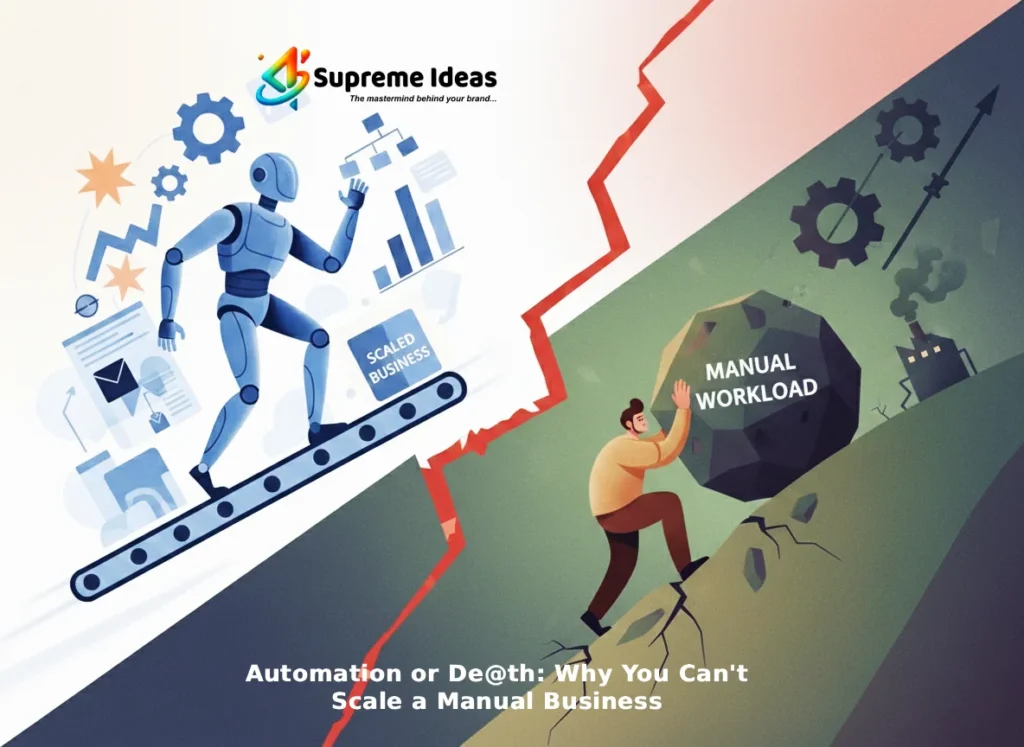
There is a famous piece of startup advice that gets thrown around constantly: “do things that don’t scale.” paul graham wrote it, and it’s brilliant advice for your first thirty days in business. when you have zero customers and nobody knows who you are, you have to do things manually. you have to hand-write cold emails, you have to jump on airplanes for a single meeting, you have to manually onboard your first three beta users and hold their hands through every single click.
doing things that don’t scale is how you find product-market fit.
but here is what they don’t tell you: once you find product-market fit, continuing to do things that don’t scale is a form of operational suicide.
i see founders who hit $30,000 a month in revenue, and they are still running their business exactly the same way they did at $3,000 a month. they are manually generating Stripe invoices. they are copying and pasting client data from a web form into a Google Sheet. they are sending individual calendar links to prospects and playing email ping-pong to find a time to meet.
they are exhausted. their eyes are bloodshot. they think this is just what “hustle” looks like.
it’s not hustle. it’s incompetence.
a business that relies on human beings to execute repetitive, predictable tasks is not a business. it is a fragile, highly stressful job that you have created for yourself. humans are terrible at repetitive tasks. we get tired. we forget attachments. we misspell names. we sleep for eight hours a day, which means the business completely stops moving for a third of its existence.
if you want to cross the chasm from a chaotic startup to a seven-figure machine, you have to realize that code is cheaper, faster, and more reliable than human labor. you have to fire yourself from the administration of your company.
this is the definitive guide to automation. we are going to tear down the psychological barriers that keep founders trapped in the weeds. we are going to look at the exact difference between a manual choke point and an automated growth engine. we will look at how to build the “invisible robots” that run your operations, and we will define the exact point where automation must stop and human connection must take over.
if you do not automate your baseline operations, you will die of exhaustion, or your competitors will simply outpace you because their cost of delivery is zero.
let’s build the machine.
The Physics of Manual Labor: Why the Math Always Breaks
to understand why you must automate, you first have to look at the brutal physics of a manual business model.
when you operate manually, your revenue is permanently chained to your headcount. if it takes one human being four hours to onboard a new client, set up their project management board, send their welcome emails, and provision their software accounts… then you have a massive mathematical ceiling on your growth.
if you suddenly have a viral marketing moment and 50 new clients sign up in one day, what happens?
you can’t process them. your team is buried. 50 clients multiplied by 4 hours of manual onboarding equals 200 hours of human labor. your team has to work through the weekend just to send welcome emails. mistakes happen. clients get the wrong deliverables. the entire system implodes because you tried to push a firehose of volume through a cocktail straw of human bandwidth.
The Illusion of “Just Hiring More People”
when founders hit this bandwidth wall, their default reaction is always the same: “we need to hire more people.”
this is a catastrophic mistake. throwing human bodies at an operational bottleneck is the fastest way to destroy your profit margin.
-
The Bad Approach: A client agency hits capacity. The founder hires three more junior account managers at $50k a year each to handle the manual data entry, reporting, and onboarding. The overhead explodes. The founder now has to spend 20 hours a week managing these three new humans, dealing with their sick days, their mistakes, and their interpersonal drama. Revenue went up, but profit and sanity went down.
-
The Good Approach: The founder realizes the onboarding and reporting tasks are predictable. They spend one weekend mapping the process and linking their CRM to their project management tool via Zapier. When a client signs the contract, the software automatically creates the folders, sends the emails, and populates the data. The founder just reclaimed 40 hours a week of capacity without adding a single dollar to the payroll.
humans should be hired to solve complex, creative problems. humans should be hired to do high-stakes sales, write brilliant copy, or architect new products.
if you are paying a human being to move data from Column A to Column B, you are burning cash.
What Most People Misunderstand About Automation
people think automation is about “replacing” their team. it’s not. it’s about elevating them.
when you automate the mundane, repetitive garbage that your team hates doing anyway, you free up their cognitive bandwidth to actually service the client. an account manager who doesn’t have to spend three hours a day formatting spreadsheet reports is an account manager who can spend three hours a day calling clients, building relationships, and upselling them into higher-tier packages.
automation doesn’t kill jobs; it kills the robotic parts of the job so the human can actually act like a human.
The “White Glove” Delusion: Why Bespoke is Usually Bad
the most common objection i hear from founders when i tell them to automate their delivery is this:
“my clients pay a premium price. they expect a white-glove, bespoke experience. i can’t just put them through an automated sequence, it will feel cheap and robotic.”
i beleive that founders actually think this is true, but it is a massive delusion. it is an ego trap.
you think your manual emails are “bespoke” and “charming.” the client thinks your manual emails are slow, riddled with typos, and inconsistent.
The Reality of the Customer Experience
let’s look at a real-world scenario of a client signing a $10,000 consulting contract.
Scenario A (The Manual “White Glove” Founder): The client signs the DocuSign at 8:00 PM on a Friday. The founder is out to dinner. The founder sees the notification, smiles, but decides to deal with it on Monday morning. The client has just spent $10k and hears absolutely nothing for 48 hours. They experience massive buyer’s remorse all weekend. On Monday at 11:00 AM, the founder manually types out a “Welcome!” email, forgets to attach the intake form, and sends a broken Calendly link.
Scenario B (The Automated Machine): The client signs the DocuSign at 8:00 PM on a Friday. Exactly three minutes later, a highly polished, beautifully formatted welcome email lands in their inbox. It says, “We are thrilled to have you. Here is exactly what happens next.” It includes a link to a private onboarding portal that was auto-generated via API. It contains a video from the founder welcoming them. It clearly outlines the timeline.
which one feels more “premium”?
the automated one wins every single time. true luxury is not about human struggle; it is about the absence of friction. code does not take the weekend off. code does not forget attachments. code delivers the exact same flawless experience to the 1st client and the 1,000th client.
Contrast: Predictability vs. Personalization
what founders misunderstand is the difference between predictability and personalization.
you can automate personalization. if your intake form captures their industry, their biggest pain point, and their company name, your automated onboarding sequence can dynamically insert those variables into the emails.
“I know scaling your [SaaS] company is causing a lot of [churn issues], and our team is ready to dive in.”
it feels deeply personal to the client, but it was executed by a machine. you get the conversion benefits of intimacy with the margin benefits of automation. (no, really, people fall for this all the time. they will reply to a heavily automated email sequence thanking you for taking the time to write to them personally).
Mapping the Machine: You Can’t Automate Chaos
so, you are convinced. you want to automate. the mistake most founders make next is running out and buying 15 different software tools and trying to connect them all at once.
they log into Zapier, stare at the screen, get completely overwhelmed, and quit.
you cannot automate a process that you do not deeply understand. if your current manual process is chaotic, and you try to automate it, you will just execute chaos at the speed of light.
before you touch a single line of code or a single webhook, you have to map the machine.
The “If This, Then That” (IFTTT) Architecture
every automation in the world, from a simple email autoresponder to the algorithm that runs Amazon’s supply chain, is built on the exact same logic: If This, Then That.
-
The Trigger (If This): What is the exact, binary event that starts the chain? It must be measurable. “A client pays an invoice.” “A prospect fills out a form.” “A tag is added in the CRM.”
-
The Action (Then That): What is the exact sequence of events that must occur without human intervention?
The Sticky Note Audit
to build your map, you need a blank wall and a stack of sticky notes.
walk through your core business processes (Acquisition, Onboarding, Fulfillment, Support). write every single manual step on a sticky note.
-
Note 1: Prospect books a call on Calendly.
-
Note 2: I manually create a deal in Pipedrive.
-
Note 3: I manually copy their website URL into a research doc.
-
Note 4: I manually send them a reminder email 24 hours before the call.
look at that wall. every single sticky note that requires you to move data from one place to another is a target for assassination.
-
The Bad Approach: Looking at the wall and saying, “I’ll just hire an assistant in the Philippines to do these steps.” You are still relying on human memory and paying a recurring salary for a robotic task.
-
The Good Approach: Looking at the wall and saying, “If Calendly is the Trigger, what can the API do?” You build a single Zapier workflow: When Calendly is booked -> Create Deal in Pipedrive -> Create Google Doc with prospect’s URL -> Send pre-written reminder email 24 hours prior.
you just eliminated four sticky notes and bought back three hours of your week.
The Tech Stack Trap: Avoiding Subscription Bloat
once you understand the mapping, you have to choose your tools. this is the second place founders die.
they fall victim to marketing. they think they need Salesforce, Hubspot Enterprise, Marketo, and a custom-coded backend just to run a $500k a year agency. they end up with a “Franken-stack” of tools that cost $4,000 a month and require a full-time engineer just to keep them talking to each other.
this is the Tech Stack Trap.
The Hub-and-Spoke Model
a scalable automated business does not need 50 tools. it needs three core hubs, and a handful of specialized spokes.
1. The Source of Truth (The CRM): This is the brain of your business. Whether it’s Hubspot (the free/starter version), ActiveCampaign, or GoHighLevel. Every single piece of customer data must flow back to this central hub. If data lives in a spreadsheet on your desktop, it doesn’t exist. 2. The Financial Engine (Stripe/Quickbooks): This handles the money. It must be strictly integrated with your CRM so that when a payment happens, the CRM knows about it instantly. 3. The Glue (Zapier / Make.com): This is the nervous system. Zapier sits in the middle and watches the hubs. When the Financial Engine says “Payment Received,” the Glue catches that signal and tells the CRM to change the client’s status to “Active,” which triggers the onboarding emails.
-
What most people misunderstand: You do not need expensive “all-in-one” tools that are mediocre at everything. You need highly specialized, cheap tools that are connected by the Glue.
for example, instead of paying $2,000 a month for enterprise software that includes a clunky e-signature feature, you use a $15/month PandaDoc account, a $49/month CRM, and a $30/month Zapier account. the Glue makes them function as a single enterprise tool for a fraction of the cost.
The Danger of Custom Code
unless you are literally building a software startup, you should avoid custom code at all costs in the early and mid-stages.
“i’ll just pay a dev $5k to build me a custom dashboard that hooks into these APIs.”
don’t do it. APIs change. webhooks break. when they do, your custom code is useless, and you have to pay the dev another $5k to fix it.
stick to native integrations and verified Zapier/Make connections for as long as humanly possible. visual automation builders allow you, the founder, to fix a broken pipeline at 10:00 PM on a Sunday without needing to know Python. flexibility is your ultimate competitive advantage.
Automating the Acquisition Engine: The Top of the Funnel
let’s get into the high-leverage application of these systems. the most profitable place to deploy automation is at the top of your sales funnel.
if you are manually prospecting, you are operating at the speed of human typing. you can maybe send 50 personalized emails a day before your brain turns to mush.
if you want to scale, you need to be having 500 conversations a day.
The “Always On” Lead Machine
you must build a system that works while you sleep. this requires shifting from manual outbound to automated inbound and programmatic outbound.
The Automated Inbound System: you create a high-value piece of content (a lead magnet, a free mini-course, a deep-dive PDF). you run targeted ads to it. when a prospect enters their email to get the PDF, the automation takes over.
-
The Bad Approach: They get the PDF, and then you manually email them three days later saying, “hey, did you like it? want to buy my thing?” They ignore you because you are a stranger.
-
The Good Approach: The CRM triggers a 14-day automated “Soap Opera Sequence.” Day 1 delivers the PDF. Day 2 tells an emotional story about your founding journey. Day 4 agitates their core business pain. Day 6 introduces your methodology. Day 8 makes a soft pitch to book a call.
this sequence is entirely automated. it runs for a thousand people simultaneously. by the time a prospect actually clicks the link to book a calendar appointment with you, they have consumed hours of your content. they already trust you.
you completely automated the trust-building phase of the sales cycle.
Programmatic Outbound (The Right Way)
automation also applies to outbound sales, but this is where people get lazy and become spammers.
spam is blasting the exact same generic message to 10,000 people. it doesn’t work. it destroys your domain reputation.
programmatic outbound is using automation to scale hyper-personalization.
you use tools (like Apollo or Instantly) to scrape a highly targeted list of 500 prospects. you use automation to pull in dynamic variables: their company name, a recent news article about their funding round, the specific software they use on their website.
your automated email says: “Hi [First Name], saw that [Company Name] just raised a Series A—congrats. Noticed you are using [Competitor Software] on your site. Most of our clients at that stage find [Competitor Software] breaks down around 50 employees. We built a system that fixes that exact leak. Open to a 5-minute chat?”
the software sends 100 of these a day. it automatically follows up on Day 3 and Day 7 if they don’t reply. the moment they reply, the automation stops, and the human (you or your sales rep) steps in.
you just built a robot that does the miserable work of cold prospecting, allowing your human sales team to spend 100% of their time talking to people who actually replied.
The Human Handoff: Knowing Where Code Must Stop
this is the nuance that separates brilliant strategists from lazy founders.
automation is intoxicating. once you realize you can replace human labor with a $30 Zapier subscription, you want to automate everything. you want to automate the sales calls. you want to automate the client strategy sessions. you try to build AI chatbots to handle high-level customer complaints.
and suddenly, your brand feels cold, dead, and utterly soulless.
you must understand the concept of the Human Handoff.
automation is for administration. humans are for connection.
The Law of High-Stakes Interaction
any time a client is making a massive financial decision, or experiencing a massive emotional problem, a human being must be present.
-
The Bad Approach: A client emails your support desk saying, “My campaign crashed and we are losing thousands of dollars right now!” You have an automated AI bot reply with, “I’m sorry to hear that! Have you checked our FAQ database?”
that client is going to cancel their contract and sue you.
-
The Good Approach: The client emails support. The automation reads the keywords “crashed” and “losing money” and instantly routes the ticket to the VIP emergency queue. It triggers an SMS alert to the founder’s phone. The founder calls the client manually within 5 minutes.
you used automation to speed up the routing, but you used a human to handle the crisis.
Automate the Pre-Work, Humanize the Delivery
if you are a high-ticket consultant, do not try to automate the consulting.
you automate the calendar booking. you automate the intake questionnaire. you use a system to automatically pull their website analytics into a dashboard before the call.
but when the Zoom call starts, you are deeply, profoundly present. you aren’t shuffling papers or asking basic demographic questions, because the automation already handled that. you can spend the entire 60 minutes looking them in the eye, listening to their deep psychological fears, and providing high-level strategy.
you use automation to buy yourself the time and the cognitive space to be a better, more present human being when it actually matters.
that is the ultimate power of the machine.
Surviving the Implementation Dip
i have to warn you about what happens when you actually start doing this.
building automations is frustrating. APIs will break. webhooks will fail. you will spend three hours trying to figure out why a piece of text isn’t formatting correctly in a Google Doc.
you will look at the clock and think, “i could have just done this manually in 15 minutes! this automation stuff is a waste of time.”
this is called the Implementation Dip. it is the psychological barrier that keeps 90% of businesses trapped in the manual dark ages.
The Math of Long-Term Leverage
yes, it might take you three hours to build an automation for a task that only takes 15 minutes to do manually.
but you have to think like an investor, not a laborer.
if that 15-minute task happens four times a day, that is an hour of your life every single day. that is 365 hours a year.
you are trading 3 hours of frustrating, upfront implementation work to buy back 365 hours of your life this year. and next year. and the year after that.
it is the highest ROI investment you can possibly make.
when you are in the Implementation Dip, and the Zapier error logs are driving you insane, you have to remind yourself that you are not just fixing a workflow. you are building an asset.
every automation you successfully deploy is a micro-employee that works 24/7/365, never asks for a raise, never gets sick, and executes its instructions with mathematical perfection.
Common Objections and Reality Checks
let’s address the excuses that founders use to avoid doing this work.
“My business is too custom, every client is different.” this is a symptom of a broken business model, which we covered in the $10k to $1M roadmap. if every client is so wildly different that you can’t even automate the invoicing or the onboarding, you don’t have a scalable business. you must standardize your offer before you can automate your operations. you can’t automate a moving target.
“I’m not technical, i don’t know how to code.” you don’t need to know how to code. the “no-code” movement has completely democratized software engineering. if you can build a flowchart on a whiteboard, you can build an enterprise-grade automation in Make.com or Zapier. it is entirely drag-and-drop. ignorance is no longer a valid excuse; it is just a choice to remain inefficient.
“I don’t have time to build systems, i have to service my clients.” if you are too busy driving to stop for gas, you are going to crash on the side of the highway. you have to intentionally slow down your acquisition. block out four hours every saturday morning. call it your “Machine Time.” do not do client work during this time. just build one automation a week. after 52 weeks, you will have a completely different company.
Conclusion: Becoming the Architect
at the end of the day, a business is simply a collection of systems designed to acquire customers and deliver value.
if those systems are made of human muscle, human memory, and human willpower, your business is fragile. it is capped by the biological limits of the people running it. if you get the flu for a week, the business stops.
if those systems are made of code, triggers, and logic, your business is anti-fragile. it scales effortlessly. it can process ten orders a day or ten thousand orders a day with the exact same level of overhead.
the shift from a manual business to an automated business requires a fundamental shift in your identity as a founder.
you have to stop finding pride in how hard you work. you have to stop bragging about the 80-hour weeks and the hustle.
you have to start finding pride in how little you actually have to do to make the machine run. you must become obsessed with leverage.
when you look at a problem, your first instinct can no longer be, “how do i solve this?” your first instinct must be, “how do i build a system that solves this forever, so i never have to look at it again?”
that is the difference between owning a job and owning an asset. that is the difference between a high-stress hustle and a high-margin empire.
…anyway, go look at your sticky notes. figure out what you did manually today that a robot could have done for free. and then fire yourself from that job by tomorrow morning.