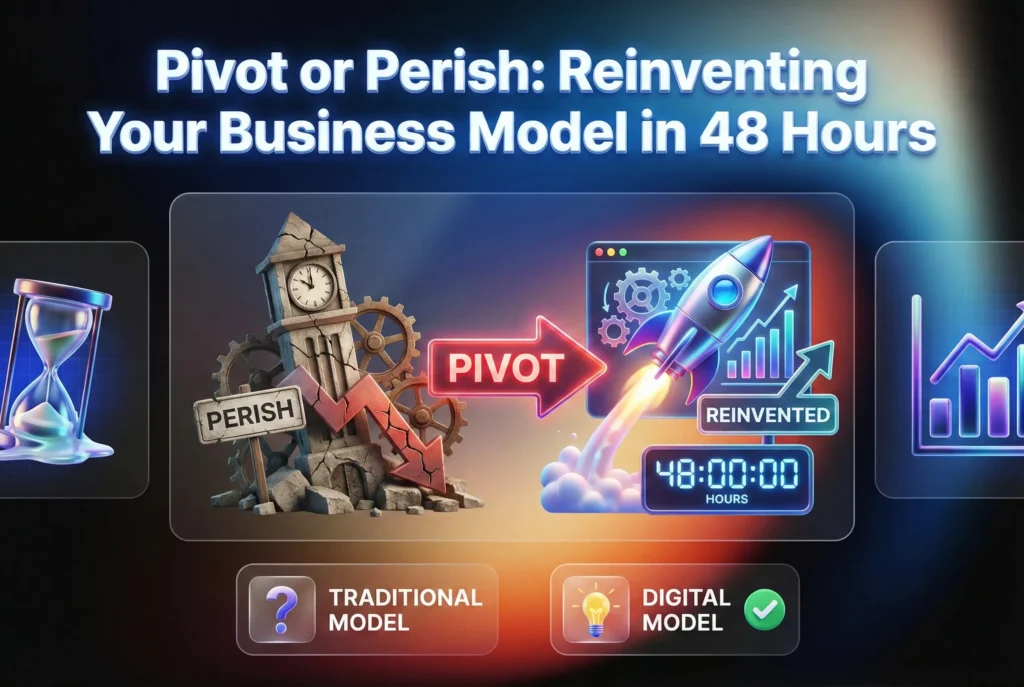
There is a lie told in the startup community that persistence is the ultimate virtue. you see it on linkedin every day. people quoting steve jobs or elon musk, talking about how they “stayed the course” when everyone else told them to quit. they tell you to keep pushing, keep grinding, and eventually, the market will magically realize you were right all along.
this is survival bias disguised as strategy.
for every one visionary who stayed the course and built a unicorn, there are ten thousand exhausted, bankrupt founders who stayed the course right off a financial cliff. they kept pouring money into facebook ads for a product nobody wanted. they kept trying to sell a “nice to have” software during an economic downturn. they spent three years polishing a turd because their ego wouldn’t let them admit that their original hypothesis was fundamentally, mathematically broken.
sometimes, persistence is just a polite word for delusion.
if your business is bleeding cash, if your sales cycles are agonizingly long, if you feel like you are dragging a boulder up a hill just to get a single customer to say “yes”… you do not need better marketing. you do not need a new website design. you do not need to wake up at 4:30 am to journal.
you need a new business model. and you need it right now.
this is the definitive, brutal guide to the 48-hour pivot. we are going to look at the exact mechanics of tearing your company down to the studs and rebuilding it before the runway runs out. we will cover the psychology of sunk costs, the specific four-axis framework for reinventing your offer, and the hour-by-hour timeline for launching a fundamentally new business without writing a single line of code.
we are not talking about a “brand refresh.” we are talking about a violent, structural reinvention of how you capture and deliver value.
if you do not master the art of the pivot, the market will pivot right over you.
The Diagnosis: Are You Dead, or Just Bleeding?
before you burn the boats, you have to look at the map. the biggest mistake founders make in a crisis is misdiagnosing the problem.
they see revenue dropping, so they panic and change the product. but the product was fine; their pricing model was just broken. or they change the pricing, but the pricing was fine; they were just selling to the wrong demographic.
you have to know exactly what is broken before you can fix it.
The Unit Economics Acid Test
a business model is only broken if the unit economics are irreversibly inverted.
unit economics simply means: how much does it cost to acquire one customer (CAC), and how much profit does that one customer bring you over their lifespan (LTV)?
if it costs you $500 in ad spend and sales commissions to acquire a customer, and that customer only ever pays you $300 before they churn… your business model is dead. it does not matter how good your product is. it does not matter how much your mom loves your logo. every time you make a sale, you lose $200.
-
The Misunderstanding: Founders look at this and say, “we just need economies of scale! if we get more volume, our costs will go down!”
-
The Reality: Economies of scale apply to manufacturing physical goods in massive factories. In the digital, service, and SaaS world, scaling a negative margin just means you go bankrupt exponentially faster.
The “Vitamin vs. Painkiller” Reality Check
if your unit economics are technically okay, but your conversion rate is abysmal (meaning nobody wants to talk to your sales team), you are likely suffering from a positioning failure.
we have discussed this in previous guides, but in a crisis, it is the first thing you must audit. are you selling a vitamin or a painkiller?
vitamins optimize an already good situation. “our software makes your team 10% more collaborative.” painkillers stop a lethal bleed. “our software catches compliance errors that would otherwise result in a $50,000 regulatory fine.”
if the market is rejecting you, it is almost always because they perceive you as a vitamin. they don’t have the budget or the cognitive bandwidth to care about “collaboration” right now. they only care about survival.
Good vs. Bad Pivot Triggers
-
Bad Trigger: You launch a new product, run $500 in ads over one weekend, get zero sales, and immediately decide to pivot to a completely new industry because “facebook ads don’t work.” (You didn’t give the model time to breathe. You just have weak conviction).
-
Good Trigger: You have spent six months doing 100+ sales calls. You have tweaked the pitch, offered discounts, and tried three different lead sources. Your close rate is still under 5%, and the few clients you do close are complaining that the product is too complicated. (The market is screaming at you that the model is wrong. It is time to pivot).
The Psychology of the 48-Hour Constraint
why 48 hours? why not take a month to carefully plan the pivot, do market research, and ease into the new model?
because if you give a founder a month to pivot, they will spend that month finding excuses not to do it.
parkinson’s law states that work expands to fill the time allotted for its completion. if you give yourself 30 days to reinvent your company, you will spend 20 days agonizing over the new logo, 5 days arguing with your team about the vision, and 5 days building a bloated product roadmap that you can’t afford to execute.
the 48-hour constraint is a psychological weapon. it is designed to bypass your ego and force you into pure survival mechanics.
The Sunk Cost Fallacy (Killing Your Darlings)
the hardest part of the 48-hour pivot is looking at the thing you spent the last two years building and deciding to throw it in the trash.
you spent $50,000 building a custom app backend. you spent a year writing a 400-page proprietary methodology for your consulting firm.
your brain will desperately try to save those assets. “we can’t just abandon the app! we spent so much money on it! let’s try to repurpose it.”
this is the Sunk Cost Fallacy. the money and time are already gone. they do not exist anymore. if the app does not serve the new business model, the app is a liability. every day you spend trying to keep it alive is a day you are stealing from your future survival.
you have to kill your darlings. you have to look at your business with the cold, detached eyes of a private equity liquidator. (yes I know that sounds dramatic—whatever, it’s the only mindset that works when you are bleeding cash).
The Speed of Imperfection
in 48 hours, you cannot build a perfect new business.
you cannot write custom code. you cannot produce a high-end video sales letter. you cannot set up complex, multi-stage automated marketing funnels.
you are going to build a frankenstein monster. you are going to use duct tape, Zapier, a basic Carrd landing page, and a Stripe checkout link.
the goal of the 48-hour pivot is not to launch a finished company. the goal is to get a completely new, radical hypothesis into the market fast enough to see if a stranger will hand you a credit card. if they do, you validate the new model, and then you spend the next six months making it pretty.
The 4 Pillars of a Pivot: You Only Need to Change One
when founders think about a pivot, they usually think they have to change everything. they think they need to leave the healthcare software industry and start a dog-walking agency.
that is not a pivot. that is starting over from scratch, which wastes all your accumulated domain expertise.
a true pivot is a surgical adjustment to one or two pillars of your business model. there are four pillars you can manipulate:
1. The Audience (Who you sell to) 2. The Problem (What pain you solve) 3. The Solution (How you solve it) 4. The Mechanism/Pricing (How you deliver and charge for it)
if your current model is dying, you hold three pillars constant and violently alter the fourth.
Pivot Type 1: The Audience Pivot
your product is great, but the people you are selling it to are broke, or they are too hard to reach, or they don’t value your time.
-
Scenario: You run an SEO agency for local restaurants. You are charging $500 a month. The restaurants are cheap, they micro-manage you, and they churn constantly because restaurant margins are razor-thin.
-
The Pivot: You change nothing about the service (SEO). You just change the audience. You take your exact same SEO strategies and you start pitching B2B Enterprise SaaS companies. B2B SaaS companies have massive budgets and high lifetime customer values. You raise your price from $500 a month to $5,000 a month.
-
The Result: You went from a high-stress, low-margin nightmare to a high-margin premium agency, simply by pointing your exact same skills at a richer demographic.
Pivot Type 2: The Problem Pivot
you have the right audience, but you are trying to solve a problem they don’t actually care about (the vitamin problem).
-
Scenario: You sell “Culture Analytics” software to HR directors. The software polls employees to see how happy they are. During a recession, nobody is buying it.
-
The Pivot: You realize that HR directors are currently terrified of wrongful termination lawsuits during mass layoffs. You take your existing polling software, strip away the “happiness” branding, and repackage it as “Compliance & Exit Interview Documentation” software.
-
The Result: You are still selling software to the same HR director, but you stopped selling a morale vitamin and started selling a legal painkiller.
Pivot Type 3: The Solution Pivot
you have the right audience, and you know their exact pain, but the way you are currently trying to solve it is operationally bankrupting you.
-
Scenario: You are a high-end copywriter doing completely bespoke, custom website copy for startup founders. It takes you three weeks to do one project. You are capped at $10k a month and you are working 80 hours a week.
-
The Pivot: You realize the founders don’t actually need you to write it from scratch; they just need it to convert. You pivot from “Done For You” to a “Productized Workshop.” You charge $2,000 for a 4-hour group zoom call where you teach 10 founders your exact copywriting frameworks and give them your templates.
-
The Result: You deliver the solution (better copy) but you completely changed the delivery mechanism. You just made $20,000 in four hours instead of $10,000 in three weeks.
Pivot Type 4: The Pricing/Mechanism Pivot
your product works, the audience loves it, but the way you charge for it is breaking your cash flow.
-
Scenario: You sell a complex data-scraping tool to sales teams for a one-time fee of $1,000. You have to constantly hunt for new customers every single month to make payroll because you have zero recurring revenue.
-
The Pivot: You move to a subscription model. You drop the upfront price to $0, but you charge $199 a month for access to the tool and the ongoing data updates.
-
The Result: You take a short-term hit to cash flow, but within six months, your MRR (Monthly Recurring Revenue) compounds, stabilizing the entire company.
when you look at your dying business, ask yourself: which of the four pillars is the anchor dragging me down? find the anchor, cut the chain, and replace it.
The 48-Hour Timeline: Hour 0 to 12 (The Autopsy and Extraction)
the clock starts now. you are locked in a room. turn off slack. put your phone in another room. you have 48 hours to save your life.
the first 12 hours are entirely dedicated to the autopsy. you have to figure out what parts of the dead business are actually worth salvaging.
The 80/20 Customer Audit
most of your clients are terrible, but somewhere in your CRM, there is a tiny pocket of clients who love you. you have to find them.
export your entire client list for the last two years into a spreadsheet. you are looking for the “Core 20%” (we covered this in the Profit Audit, but now we are doing it for survival).
filter the spreadsheet by these parameters:
-
Who paid the highest price with the least amount of negotiation?
-
Who got the fastest, most undeniable ROI from our work?
-
Who required the least amount of customer support?
you will likely find a bizarre pattern. maybe you are a general marketing agency, but you realize that the three clients who fit all these criteria were all local roofing companies.
boom. you are no longer a general marketing agency. as of hour 4, you are now a hyper-specialized lead generation firm for commercial roofing contractors.
The “Feature Extraction” Protocol
if you run a software company or a complex service, you have probably built 50 different features. your clients probably only use two of them.
you have to look at your analytics (Mixpanel, Google Analytics, or just look at your support tickets). what is the one specific action that your users take the most often?
i once watched a massive, bloated B2B event management platform realize they were going bankrupt. they had built ticketing, seating charts, live streaming, and networking apps. it was a disaster to maintain.
they did an autopsy. they realized that 90% of their users only logged in to use their proprietary “badge printing” software, which was just one tiny feature hidden in the menu.
they took a machete to the business. they killed the live streaming. they killed the seating charts. they pivoted the entire company to be exclusively “The world’s fastest on-site badge printing software for enterprise events.”
they stripped away all the bloat, kept the one feature that actually solved a bleeding neck, and their valuation 10x’d over the next two years.
in hours 0 to 12, your only job is to find the badge printer. find the one thing you do that actually matters, and prepare to throw the rest away.
Hour 12 to 24 (The Frankenstein Rebuild)
you have your new hypothesis. you found the target audience (roofers) or you found the core feature (badge printing).
now, you have 12 hours to build the new business model. you cannot code anything. you must use the Frankenstein method.
The Wizard of Oz MVP (Again, But Faster)
we talked about the Wizard of Oz test in the $0 validation guide. you are going to use it again here, but under extreme duress.
you must figure out how to deliver the new solution entirely manually, using off-the-shelf software, before tomorrow morning.
-
Scenario: You are pivoting from a struggling “SaaS project management tool” to a high-ticket “Done-For-You Operations Consulting” model.
-
The Rebuild: You do not need a new software backend. You need a Typeform for onboarding. You need an Airtable to track the client data. You need a Google Drive folder structure for the deliverables. You need a Stripe checkout link that charges $5,000 upfront.
that’s it. you stitch these free or cheap tools together using Zapier. if the client pays the Stripe link, they get an automated email with the Typeform link. when they fill out the Typeform, Zapier creates their client profile in Airtable and spins up a dedicated Google Drive folder.
you just built a fully functioning enterprise onboarding system in four hours for $30 a month.
-
The Bad Approach: Saying, “We can’t launch this new consulting model until we build a custom client dashboard so it looks professional.” (You waste three months, run out of cash, and die).
-
The Good Approach: Letting the client see the duct tape. “Hey, because this is our new elite beta cohort, we are managing everything directly in a shared Airtable base for maximum transparency and speed.” You reframe the lack of a custom dashboard as a feature of your hands-on approach.
The Radical Pricing Shift
in this 12-hour window, you must also redefine your pricing.
if you are pivoting because your business is dying, your current pricing is almost certainly too low to support your operations.
this is your chance to reset the anchor.
when you introduce the new model, you must instantly target the premium segment of the market. if you were charging $500 a month for your old service, your new, hyper-specialized, pain-killer pivot must cost $3,000 a month.
why? because when you pivot, you are going to lose volume. you will have fewer clients. you must extract significantly more margin from the clients who remain in order to survive the transition.
do not be afraid of the price jump. you are no longer selling the old, generic vitamin. you are selling a highly specific, surgical painkiller. charge for the surgery.
Hour 24 to 36 (The Burn Down and Reposition)
it is now day two. the backend is built out of duct tape and Airtable. the new pricing is set.
now you have to burn the old brand to the ground and write the new one.
The “Anti-Pitch” Landing Page
you do not have time to hire a web designer. you do not have time to migrate to a new WordPress theme.
you take your current website. you delete every single page except the homepage. you strip the homepage of all images, all complex formatting, and all generic corporate jargon (“synergistic solutions for modern teams” – delete it all).
you are going to write an ugly, brutal, highly converting text-based landing page.
the copy must follow the Anti-Pitch Framework. it must call out the exact pain of the new audience, explicitly state who the service is not for, and present the new mechanism.
-
Headline: Stop losing commercial roofing bids because your follow-up speed is too slow.
-
Sub-headline: We build automated SMS lead-capture systems exclusively for 7-figure commercial roofers.
-
The Anti-Pitch: We are not a full-service marketing agency. We don’t do your SEO. We don’t post on your Instagram. We do one thing: we install a system that guarantees your sales team calls every inbound lead within 60 seconds of them filling out a form.
-
The Filter: If you are doing residential roofs for under $1M a year, this is not for you. This is a $3,000/month infrastructure play for commercial operators who are losing $50k contracts to faster competitors.
-
The Call to Action: Book a 15-minute deployment call.
this page will take you two hours to write. it will be ugly. it will be aggressive. and it will convert 10x better than your beautiful, generic, $10,000 website ever did, because it speaks directly to a bleeding neck.
The Domain Name Delusion
founders get deeply attached to their brand names. “i can’t pivot to just serving roofers! my domain is ‘https://www.google.com/search?q=OmniGlobalMarketing.com’!”
nobody cares about your domain name. nobody cares about your LLC structure.
if your current domain name doesn’t fit the pivot, go to Namecheap, buy “CommercialRoofingSystems.co” for $8, point it to a Carrd landing page, and run the whole new business under a “DBA” (Doing Business As) attached to your old LLC.
do not let legal and branding friction slow down the 48-hour launch. the market does not care what name is on the bottom of the invoice as long as the problem gets solved.
Hour 36 to 48 (The Collision and the Cash Grab)
this is the final stretch. the trap is set. now you have to drive traffic into it and see if the trap actually catches anything.
you do not have time for SEO to rank. you do not have time to build a three-week facebook ad campaign. you need cash today to prove the pivot works.
The Internal “Hail Mary” Email
your biggest, fastest source of liquidity is your existing email list or your linkedin connections.
you are going to send the most honest, vulnerable, and aggressive email you have ever written.
-
Subject: We are killing our core service (and launching a private beta).
-
Body: “For the last two years, we have run [Old Company Name]. We helped a lot of people, but behind the scenes, we realized that our generic approach wasn’t solving the deepest problem our best clients were facing. So, today, we are burning the old model down. We are pivoting 100% of our company’s resources to focus entirely on [New Highly Specific Problem]. We have spent the last few weeks building a completely new architecture for this. It’s faster, it’s vastly more effective, and it’s expensive. We are looking for 5 “Beta” companies to run through this new system next week. The retail price will be $5,000. For these first 5 companies, it will be $2,500. If your company is struggling with [Specific Pain], reply to this email with the word ‘BETA’ and we will get on a call this afternoon.”
-
Why this works: People love transparency. People love inside access. By admitting that your old model was flawed, you build massive trust. By limiting the beta to 5 spots, you create genuine urgency.
if you have an email list of 1,000 people, and you send this email, and you get zero replies… the pivot hypothesis is wrong. or your list is dead.
but usually, if you correctly identified a bleeding neck during your 12-hour autopsy, you will get 10 replies. you get on the phone. you pitch the new frankenstein model. you collect the $2,500 over Stripe.
in 48 hours, you went from a dying, bloated company to generating $12,500 in liquid cash for a completely new, highly scalable business model.
you survived the crucible.
Managing the Collateral Damage: The Fallout of a Pivot
okay, you hit hour 48. you have new money in the bank. the pivot is technically validated.
now you have to deal with the wreckage you left behind. a hard pivot creates collateral damage. you have legacy clients who are paying for the old, broken service. you have employees whose job descriptions just vanished.
how you handle the next week determines whether the pivot holds or collapses.
Firing the Legacy Clients (The Ethical Sunset)
if you pivot from a low-ticket, high-friction model to a high-ticket, productized model, you cannot keep servicing your old $500/month clients. they will drag you back into the operational black hole.
you have to fire them. but you have to do it ethically.
-
The Sunset Protocol: You email your legacy clients. “As you may have seen, our company is restructuring to focus exclusively on enterprise infrastructure. Because of this, we are officially sunsetting our legacy $500/month marketing tier. We will continue to fully support and deliver your current contract for the next 45 days to ensure a smooth transition. After that date, the service will end. Here are two other fantastic, affordable agencies we highly recommend you transition to.”
some will be angry. that is fine. you gave them 45 days’ notice and an alternative solution. you maintained your professional integrity while ruthlessly amputating the toxic revenue.
The “Wartime CEO” Team Speech
your team is going to be terrified. they just watched you tear down the website, change the pricing, and fire half the client base in two days. they think the company is going bankrupt and they are going to be laid off tomorrow.
you have to get them in a room (or on a Zoom call) and deliver the Wartime CEO speech.
you cannot sugarcoat it.
-
The Script: “I want to be completely transparent with everyone. The old business model was failing. Our margins were shrinking, and the fulfillment was burning us out. If we stayed on that path, this company would not exist in six months. So, we pivoted. We are now a highly specialized team solving [New Problem]. The good news is, we already validated it. We closed three new beta clients yesterday at a massive premium. The bad news is, the way we worked last week is dead. Your day-to-day tasks are going to change drastically. It is going to be chaotic for the next month as we build the new SOPs. If you are here for the mission and want to build this new machine with me, your jobs are secure and the upside is huge. If you prefer the old, comfortable way we used to do things, I understand, but you will not enjoy working here anymore.”
you draw a hard line in the sand.
the A-players on your team will be thrilled. they hated the old, broken model too. they will step up and help you build the new machine. the B-players and the people who just wanted to hide in the bureaucracy will self-select out and quit.
let them quit. you just naturally purged the operational fat from your payroll without having to fire them.
The Illusion of “Doing Both” (The Dual-Track Death)
this is the final trap that will kill your pivot.
founders will validate the new, high-ticket model, but they will be terrified of letting go of the old revenue completely.
so they try to run a “Dual-Track” system. “We’ll run the new elite consulting offer under this brand, but we’ll quietly keep the old cheap agency model running in the background just to pay the rent.”
this never works.
a startup only has a finite amount of cognitive bandwidth and operational momentum. if you split that momentum between two entirely different business models, you will be mediocre at both. your team will be confused about priorities. your marketing messaging will become schizophrenic.
a pivot is not a side project. a pivot is a complete biological replacement of the host organism.
you have to burn the boats. you have to cut the cord to the old revenue, even if it hurts, so that 100% of the company’s survival instinct is focused on making the new model work.
if you leave yourself a safety net, you will fall into it.
Common Objections and FAQs
when i walk founders through this 48-hour reinvention, the pushback is intense. their ego fights for survival.
“My industry moves slow. I can’t just launch a new B2B enterprise offer in a weekend.” the execution of the service might take months. the positioning and the offer can be launched in a minute. you are not launching the finished enterprise software in a weekend; you are launching the landing page, the sales thesis, and the letter of intent (LOI). you are testing if the market actually cares before you spend the next year building the slow, complex infrastructure.
“What if I pivot, and the new model fails too?” then you pivot again. this is the secret of entrepreneurship. it is not about getting it right on the first try. it is about increasing your cycle speed. if it takes you a year to build a business model and fail, you only get one shot before you run out of money. if you use the 48-hour pivot framework, you can test a completely new business model every single week. you get 52 shots a year. you will eventually hit the target. failure is just data. speed is your only defense against bankruptcy.
“Will my competitors think I’m failing if they see me pivot?” who cares what your competitors think? your competitors are probably bleeding cash and dealing with the exact same terrible unit economics you were dealing with, but they are too proud to change. let them point and laugh while you build a highly profitable, scalable machine. high-status founders do not make strategic decisions based on the opinions of people who don’t pay them.
The Reflective Conclusion: The Crucible of the Founder
reinventing your business in 48 hours is violent. it is exhausting. it will test every single assumption you have about your own intelligence and your market.
but it is also the most liberating thing you can do as an entrepreneur.
when you execute a hard pivot and survive… you lose your fear.
the fear that haunts most founders is the fear of losing the business. “what if the market changes? what if the algorithm dies? what if my whale client leaves?” they live in constant anxiety, trying to protect a fragile, static empire.
when you realize that you can tear a business down to the studs on a friday, rebuild the offer, rewrite the copy, change the pricing, and generate new cash flow by monday morning… you become practically invincible.
you realize that the business is not the asset. the business is just a temporary vehicle.
you are the asset.
your ability to look at raw data, identify a bleeding neck, construct a hypothesis, and ruthlessly execute a go-to-market strategy in 48 hours is an intellectual property that no competitor can ever steal.
the market will change. recessions will happen. algorithms will update. the things that worked yesterday will stop working tomorrow.
the founders who survive are not the ones who stubbornly stay the course. the founders who survive are the ones who can see the cliff approaching, grab the steering wheel, and rip the emergency brake without hesitation.
so look at your business model today. look at the math. look at your exhaustion levels.
if the math is broken, stop pretending you just need to work harder.
you have 48 hours. burn it down. build something better.
…anyway, your current landing page is probably lying to your customers. go fix it.