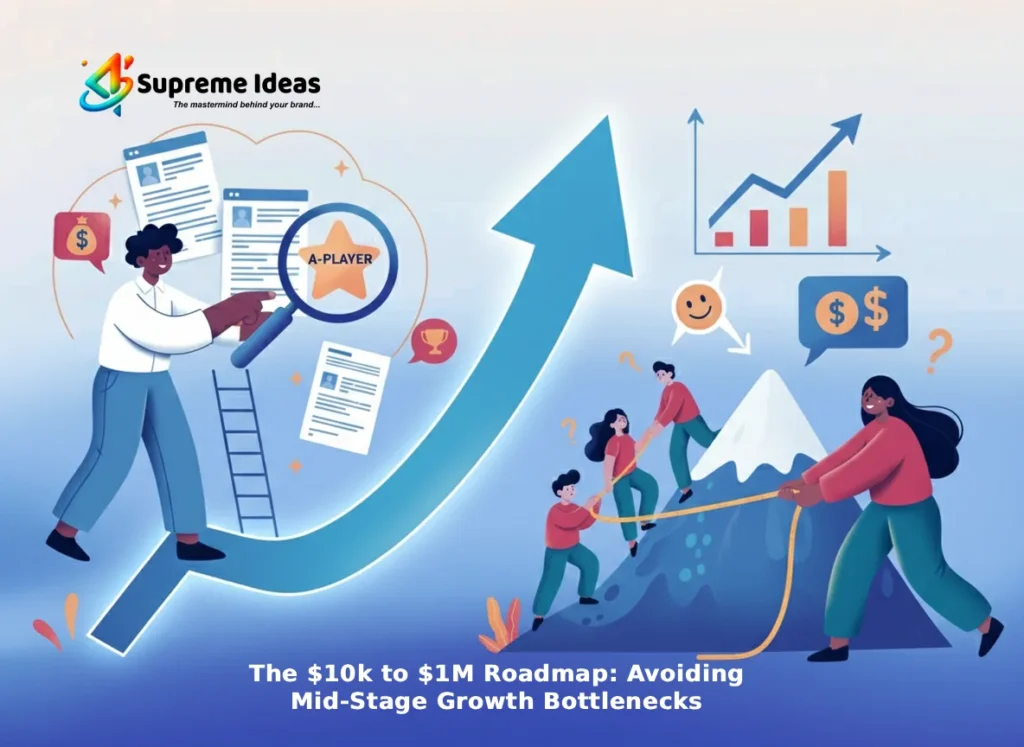
There is a massive, celebrated lie in the startup ecosystem. it goes something like this: getting your first few customers is the hardest part, and once you hit $10,000 a month in revenue, you have “made it.” you have proven product-market fit. the boulder has been pushed over the hill, and now gravity will just take over.
i mean—it’s a nice story. it makes for great motivational twitter threads. but it is complete, utter fiction.
hitting $10k a month (or roughly $100k a year) is not the finish line. it is barely the starting line. hitting $10k a month just proves that you have the capacity to hustle, that you found a few people willing to trust you, and that your idea isn’t completely stupid.
but the journey from $10k a month to $1M a year (roughly $83k a month) is a graveyard.
it is a graveyard because the exact skills, habits, and mental models that got you to $10k will actively destroy your business as you push toward $1M. at $10k, you can survive on brute force. you can answer every email, custom-build every solution, hop on every sales call, and memorize every client’s preference. you are the duct tape holding the entire operation together.
when you try to take that “duct tape and hustle” model to $50k a month, the physics of business violently break down. you drop the balls. clients churn. your team (if you have one) gets paralyzed because every decision has to pass through your exhausted brain. your profit margins compress to zero. you end up working 100 hours a week, and despite making half a million dollars a year on paper, you are taking home less money than you did when you were at $10k.
you hit the mid-stage growth bottlenecks.
this is the definitive, exhaustive guide to crossing the chasm from a successful hustle to a multi-million dollar machine. we are going to tear apart the mechanics of mid-stage scaling. we will look at the exact operational, financial, and psychological bottlenecks that will try to kill you between $10k and $1M, and we will build the exact blueprints required to bypass them.
if you don’t understand this roadmap, you will spend the next five years trapped in a prison of your own making, wondering why more revenue feels like more punishment.
The Brute Force Trap: Why “Working Harder” Fails at Scale
to fix the machine, we first have to fix the architect. we have to look at the psychological trap that ensnares almost every early-stage founder.
when you start a business from zero, your only leverage is your own labor. you don’t have capital to spend on ads, so you send a thousand cold emails. you don’t have money for a dev team, so you learn to code at 2:00 AM. you don’t have an operations manager, so you fulfill the orders yourself.
you learn a very dangerous lesson: if i want more money, i just have to apply more effort.
this creates an incredibly tight feedback loop in your brain. effort equals cash. so, when you hit $20k a month and things start feeling chaotic, your default programming kicks in. you think, “i just need to wake up at 4:30 AM instead of 6:00 AM. i just need to work weekends. i just need to push through this.”
The Mathematical Ceiling of Human Labor
this is a delusion of math. there are only 168 hours in a week. if it took you 60 hours of active labor to generate and fulfill $10k a month, you physically cannot generate $100k a month using the same model. it would require 600 hours a week.
-
The Misconception: Founders beleive that scaling is just “doing what we do now, but bigger.” They think it is a linear progression.
-
The Reality: Scaling is not linear. It is a series of structural phase shifts. Water does not just “get hotter” forever; at 212 degrees, it fundamentally changes its state from a liquid to a gas. A business does the same thing.
at the mid-stage, you cannot work harder. you have to work differently. you have to shift from being the primary engine of the business to being the architect of the engine.
Good vs. Bad Approaches to the Phase Shift
-
The Bad Approach (The Martyr): The founder refuses to let go of control. They continue to act as the primary salesperson, the primary fulfiller, and the primary customer support rep. When clients complain about delays, the founder apologizes and works until 3:00 AM to fix it. The business revenue caps out exactly at the limit of the founder’s physical exhaustion (usually around $30k-$40k MRR).
-
The Good Approach (The Architect): The founder recognizes the friction. They stop trying to process more volume through their own hands. They intentionally slow down revenue growth for a quarter to build systems, hire operators, and decouple their personal time from the delivery of the product. They accept a temporary dip in profit to buy back their bandwidth.
if you are currently sitting at $20k to $40k a month and you feel like you are drowning, it is not because you are weak. it is because you are trying to process gas through a plumbing system built for liquid. you have to change the pipes.
The Offer Bottleneck: Productization vs. Customization
the very first bottleneck you will hit on the road to $1M is your offer. what exactly are you selling, and how are you delivering it?
when you are scraping your way to $10k, you are in survival mode. if a prospect asks, “can you do X?” you say yes. even if you have never done X before. you are a custom solutions shop. you are tailoring your services to fit whatever budget and whatever bizarre requirements the client has just so you can close the deal and make payroll.
this bespoke, custom approach is exactly what gets you to $10k. and it is exactly what will bankrupt you at $50k.
The Lethal Cost of Bespoke Services
when you customize your offer for every client, you destroy your ability to scale.
think about the mechanics of customization. if Client A gets a completely different workflow than Client B, your team cannot use templates. they cannot use standardized checklists. every single project requires a “kickoff meeting” to figure out what the hell you actually promised this specific client.
because every project is different, the founder has to be involved in every project to provide “strategic direction.” you cannot hire junior people, because junior people need standard operating procedures (SOPs), and you cannot write an SOP for something that changes every time you do it.
you are forced to hire expensive, senior-level generalists. your margins compress. your delivery times stretch out. the complexity compounds until the business is paralyzed.
The “In-N-Out Burger” Menu Strategy
to cross the chasm to $1M, you must brutally simplify your offer. you have to move from a custom agency model to a Productized Service model.
look at In-N-Out Burger. they sell a billion dollars worth of food, and their menu has basically three items. burgers, fries, shakes.
because the menu is so limited, their supply chain is bulletproof. their training manual is simple. a 16-year-old can be trained to execute the system flawlessly in three days. they don’t ask you how you want your burger cooked. they don’t offer chicken nuggets. if you want chicken nuggets, you go somewhere else.
you must apply this exact philosophy to your B2B or service business.
-
The Bad Approach: “We are a full-service digital agency. We do SEO, paid ads, website design, social media management, and PR. Whatever your brand needs, we can build a custom package for you.” (This is a nightmare to fulfill. You are running five different businesses inside one company).
-
The Good Approach: “We do one thing. We build B2B outbound cold email systems for SaaS companies, and we guarantee 10 booked demos a month. Here is the exact 4-step process we use. We do not do your SEO. We do not design your website. We just build this one machine.”
when you restrict your offer, several miraculous things happen to your operational bottlenecks.
first, your sales process becomes incredibly sharp. you aren’t writing 20-page custom proposals anymore. you have one pitch, one price, and one timeline.
second, your fulfillment becomes an assembly line. because you are doing the exact same thing for every client, you can write step-by-step SOPs. you can hire junior talent to execute 80% of the work because the thinking has already been done by the system. your margins explode.
Saying No to Good Money
this is the psychological friction point. to productize, you have to be willing to say “no” to people holding a check.
a prospect will come to you and say, “i love your email system, but can you also redesign my landing page? i’ll pay you an extra $5,000.”
the $10k founder says yes, takes the money, and distracts their entire team for three weeks trying to build a landing page they aren’t equipped to build.
the $1M founder says, “No. We do not do landing pages. It dilutes our focus. I can recommend a great partner agency for that, but we only do the email system.”
it takes profound discipline to turn away revenue in the short term to protect the integrity of your assembly line in the long term. but if you do not do it, you will never escape the custom work trap.
The Sales Bottleneck: Removing the Founder from the Close
let’s assume you have productized your offer. you have a clean, sharp, repeatable service.
the next bottleneck is acquisition. how are you getting customers?
up to $10k or $20k a month, your acquisition is usually highly dependent on the founder’s personal network, word-of-mouth referrals, and pure hustle. you go to conferences, you post on linkedin, you shake hands, and you close deals because people like you and trust your personal expertise.
The Limits of “Founder Magic”
this is called Founder-Led Sales. it is essential in the beginning because nobody else knows the product or the market as well as you do. you can overcome objections purely on the strength of your passion and industry knowledge.
but Founder-Led Sales does not scale.
if the only way the business can acquire a new customer is if you personally spend 45 minutes on a Zoom call with them, your company’s growth is permanently capped by your calendar. you will eventually run out of hours in the day to do demos.
worse, you will become a prisoner to the sales pipeline. if you take a two-week vacation, the pipeline dries up, revenue flatlines, and panic sets in.
The Transition to a Predictable Sales Machine
to get to $1M, you have to extract the “Founder Magic” from the sales process and replace it with a mathematically predictable machine.
you need to be able to say: “If we put $1 into this machine, we get $4 back out. And it doesn’t matter who is turning the crank.”
this requires a three-part structural shift.
1. The Lead Generation Engine (Top of Funnel) you can no longer rely on referrals. referrals are great, but they are completely unpredictable. you cannot tell your landlord, “i’ll pay rent next week, i’m just waiting on a referral to come through.”
you must build a deterministic lead generation channel. this could be paid ads (Meta, Google, LinkedIn), outbound cold email, or a highly structured SEO/Content engine. you must track the exact Cost Per Lead (CPL) and Customer Acquisition Cost (CAC).
if you don’t know your CAC to the exact dollar, you do not have a business; you have a slot machine.
2. The Sales Assets (Middle of Funnel) why are you spending 45 minutes on a demo call explaining the same core concepts over and over again?
you must productize your pitch. you build a Video Sales Letter (VSL), a comprehensive case study document, or an automated webinar. you force prospects to consume this asset before they are allowed to book a call.
-
The Result: When the prospect finally gets on the phone, they already know what you do, how you do it, and roughly how much it costs. The 45-minute “education” call becomes a 15-minute “logistics and closing” call. You just tripled your calendar capacity.
3. The Sales Team (Bottom of Funnel) this is where founders make a catastrophic error. when a founder decides they want to step out of sales, they usually hire an expensive “VP of Sales” with a massive base salary, expecting this person to come in, build the funnel, and rain down cash.
that is a disaster. a VP of Sales from a big corporate background does not know how to sell an unproven startup product. they expect a playbook to already exist.
-
The Good Approach: You, the founder, write the playbook. You record your last 50 sales calls. You transcribe them. You build a script that handles every common objection. You prove that the script works. Then, you hire a hungry, mid-level Account Executive (AE). You hand them the script. You say, “Read this exactly as it is written. Do not deviate.”
you monitor them. when they start closing deals at an 80% success rate compared to your baseline, you have successfully extracted yourself from the sales bottleneck. you now have a machine.
The Fulfillment Black Hole: When Scale Breaks Your Operations
okay, so you productized the offer, and you built a sales machine. leads are pouring in. the AE is closing deals. you are onboarding 20 new clients a month. you are printing money.
and then the floor falls out.
this is the most dangerous phase of the $10k to $1M journey. it is the Fulfillment Black Hole.
when you force massive volume through an immature operational system, the system literally breaks apart.
The Churn Death Spiral
here is what happens. the sales team sells the dream. the new clients come in. but because you scaled sales faster than you scaled fulfillment, your delivery team is completely overwhelmed.
onboarding gets delayed. the quality of the work drops. emails go unanswered for 48 hours because the account managers are buried in spreadsheets.
the clients notice immediately. the trust gap widens. they realize they were sold a premium service but are receiving a chaotic, amateur experience. they complain. they demand refunds. they leave blistering 1-star reviews online.
then, the ultimate killer arrives: Churn. if you are adding 20 clients a month, but you are losing 15 clients a month because your fulfillment is broken, you are running on a treadmill. your net growth is almost zero, but your operational stress is at maximum capacity.
you are filling a bucket that has a massive hole in the bottom.
-
The Misconception: Founders think churn is a customer success problem. “We just need to hire friendlier account managers to smooth things over.”
-
The Reality: Churn is a product and operations problem. No amount of friendly customer service will save a client who isn’t getting the result they paid for.
Halting the Machine: The “Fix It” Quarter
if you hit the Fulfillment Black Hole, you must do something that goes against every entrepreneurial instinct in your body.
you must turn off the sales machine.
you stop marketing. you tell the sales team to pause. you cap your new client intake. (yes i know that sounds terrifying—whatever, it is the only way to survive).
you take a full quarter (90 days) and you pivot the entire company’s focus from “Acquisition” to “Retention and Delivery.”
The Architecture of Unshakeable Fulfillment
during this 90-day pause, you build the infrastructure required to handle volume.
1. The Bulletproof Onboarding Sequence the first 14 days of a client’s experience dictates their lifetime value. if they feel confused or abandoned in the first two weeks, they will eventually churn.
you must automate the heavy lifting of onboarding. they should instantly receive a welcome portal. they should fill out intake forms asynchronously. the kickoff call should be highly structured, not a casual “getting to know you” chat. they need to feel like they just stepped onto a Swiss train—everything runs exactly on time.
2. The “See, Do, Document” Factory you cannot rely on the tribal knowledge of your senior staff. if your lead media buyer gets hit by a bus (or poached by a competitor), can the rest of the team execute the ad campaigns?
you must build an internal wiki. every single task must be documented using the “See, Do, Document” framework (the founder records a loom video doing the task; the employee watches it and does it; the employee writes the step-by-step checklist).
your fulfillment center should run like a factory. there is no guessing. there is only the execution of the SOP.
3. Quality Assurance (QA) Gates when volume scales, mistakes scale. you cannot send broken work to a client. you must insert QA gates into the assembly line. the person who builds the deliverable cannot be the person who approves it for the client. you need a secondary set of eyes to run through a predefined checklist before anything ships.
it adds a day to your delivery time, but it reduces your rework and client complaints by 90%.
only when your churn rate drops back down to an acceptable level (usually under 5% monthly for B2B) are you allowed to turn the sales machine back on.
The Financial Bottleneck: Margin Compression and Cash Flow Panic
let’s talk about money. this is where the romance of “scaling” crashes into the brutal reality of accounting.
many founders are shocked to discover that they felt richer when they were making $20k a month than they do when they are making $60k a month. they look at their top-line revenue, which looks incredible, and then they look at their bank account, which is completely empty.
they assume their accountant is stealing from them. nobody is stealing from them. they have just become a victim of Margin Compression and the Negative Cash Conversion Cycle.
The Illusion of Economies of Scale
we touched on this in previous guides, but it is central to the mid-stage bottleneck.
founders assume that as they get bigger, their costs will go down. they assume economies of scale will kick in.
this is true for manufacturing physical widgets in China. it is absolutely false for scaling a service, agency, or early-stage software company.
when you go from $20k to $60k, your complexity scales exponentially, not linearly.
at $20k, you didn’t need a middle manager. at $60k, you need an Operations Director who costs $120k a year. at $20k, you used free Trello boards. at $60k, you need an enterprise Salesforce instance that costs $2k a month. at $20k, you did sales yourself for free. at $60k, you have to pay a sales rep a 10% commission on every deal.
your overhead balloons. your direct costs increase.
-
The Reality: Your gross margin might stay the same, but your Net Profit Margin gets crushed. You might grow revenue by 300%, but your operating expenses grow by 400%.
you are doing significantly more work for significantly less percentage profit.
The Cash Conversion Cycle (Why You Can’t Make Payroll)
even if you are technically profitable on a P&L statement, you can still go bankrupt if you don’t understand cash flow.
profit is an accounting concept. cash is oxygen. you cannot pay your team with “accounts receivable.”
-
The Bad Approach (The Death Spiral): You land a massive $100k contract. You celebrate. The contract says you get paid “Net-60” (the client pays you 60 days after the work is done). To do the work, you have to hire two new freelancers and buy $10k in ad spend today.
you just triggered a massive negative cash flow event. you have to float $30k in expenses for two months before you see a dime of that $100k. if you do this with five clients at the same time, you will literally run out of cash and bounce your payroll checks, even though your company is “worth” half a million dollars on paper.
growth consumes cash. rapid growth consumes cash rapidly.
Fixing the Financial Engine
to cross the chasm to $1M safely, you must become financially paranoid.
1. Flip the Cash Cycle you are not a bank. do not offer credit to your clients. you must shift your terms to get paid upfront. if you are a service business, it is 100% due before kickoff, or at least 50% upfront and 50% at a defined milestone (not “when the project is done,” because clients will delay the project for months).
if you use their cash to fund the fulfillment of their project, you can scale infinitely without ever tapping into a line of credit.
2. Defend the Net Margin you must run a microscopic audit on your P&L every single month. do not look at revenue. look at the bottom line.
if your net margin drops below 20%, you stop hiring. you stop buying software. you freeze the bloat. if you cannot maintain a healthy margin while scaling, your pricing is wrong. which leads to the next fix.
3. The Inevitable Price Hike the single fastest way to fix margin compression during the mid-stage scale is to raise your prices.
the price that got you to $10k is almost certainly too low to support the infrastructure required to get you to $1M. you are carrying more overhead now. you provide a more stable, systematic result. you must charge for the machine you have built.
every time your fulfillment pipeline gets too full, raise your prices by 20%. you will lose the bottom tier of cheap clients (which frees up bandwidth), and you will maintain your top-line revenue with vastly better profit margins.
The People Bottleneck: Hiring Operators, Not Assistants
you cannot get to $1M by yourself. you have to hire.
but the way a founder hires at $10k is fundamentally different from the way a CEO hires at $80k a month.
The “Doer” vs. The “Manager”
when you first start making money, you hire “Doers.” you hire a freelance graphic designer to make the logos. you hire a virtual assistant (VA) in the Philippines to manage your inbox and do data entry.
these are task-level employees. they are great, but they require constant management. you have to tell the VA exactly what to do every single morning. you have to check the designer’s work.
if you try to scale to $1M using only Doers, you will go insane. you will have 15 direct reports. your entire day will be spent answering Slack questions like, “hey, where is the login for the CRM?”
you will become the ultimate bottleneck.
The Shift to Hiring “Operators”
to break this bottleneck, you must shift from hiring Doers to hiring Operators (Managers).
an Operator is not someone you give a task to. an Operator is someone you give an outcome to, and they figure out the tasks required to achieve it.
you don’t tell an Operator, “Please send this email template to these 50 leads.” you tell an Operator, “Our goal is to increase the lead-to-close conversion rate by 5%. Here is the budget. I don’t care how you do it, just make it happen by Q3.”
and the Operator goes away, builds the system, hires the Doers to execute the system, and reports back to you with the result.
The “Integrator” Role (Your Second in Command)
the most important hire you will make between $10k and $1M is your Integrator.
as we discussed in the systemization framework, the founder is usually a Visionary. you like starting things, closing deals, and coming up with big ideas. you hate maintaining spreadsheets and holding people accountable to checklists.
an Integrator is your operational counterpart. they are the Chief Operating Officer (COO) or the General Manager.
they take your chaotic, brilliant ideas and they filter them. they turn them into 90-day execution plans. they hold the weekly meetings. they fire the underperforming employees. they make sure the trains run on time.
-
The Mistake: Founders delay hiring an Integrator because it is an expensive, overhead role that doesn’t directly generate sales. “I can’t afford $120k for an operations manager!”
-
The Reality: You can’t afford not to. Without an Integrator, you are the operations manager. Which means your $1,000/hr CEO brain is doing $50/hr spreadsheet maintenance, and nobody is steering the ship.
hire the operator. give them the keys to the engine room. and stay out of their way.
The Psychological Bottleneck: The Ego Death of the Founder
this brings us to the final, and most insurmountable, bottleneck on the road to $1M.
it is not a spreadsheet problem. it is not a marketing problem. it is a mirror problem.
the reason most companies plateau at mid-six figures is that the founder’s ego refuses to let the company outgrow them.
The Transition from Hero to Architect
we touched on this earlier, but it is the defining psychological shift of the mid-stage.
you built this company from nothing. it is your baby. your identity is entirely wrapped up in being the “Founder.” you love the rush of being the smartest person in the room. you love swooping in to save a dying deal. you love when clients say, “i only want to work directly with you.”
to get to $1M, you have to systematically destroy all of those things.
you have to hire people who are smarter than you. you have to sit in a meeting and realize that your VP of Marketing knows more about acquisition than you ever will, and you have to let them make decisions you disagree with.
you have to watch an employee make a mistake that costs the company $5,000, and instead of screaming at them and taking the project back, you have to use it as a training moment to improve the system.
you have to accept that your clients no longer talk to you. they talk to your account managers. and they actually prefer it that way, because your account managers are faster and more organized than you are.
The Loneliness of the True CEO
when you successfully remove yourself from sales, from fulfillment, and from daily operations… the business will feel quiet.
your Slack won’t blow up every five minutes. your phone won’t ring with emergencies.
for a founder who is addicted to the hustle, this quiet feels like death. you will feel irrelevant. you will think, “what am i even doing here? does the company even need me?”
you will be tempted to dive back into the weeds and break a system just so you can fix it and feel useful again. (no, really, founders do this subconsciously all the time. they invent a fake crisis just to feel the rush).
you must resist this urge with everything you have.
the quiet means the machine is working. the quiet is what you sacrificed the last three years of your life to achieve.
your job is no longer to be the gears of the machine. your job is to look over the horizon. your job is capital allocation. where do we deploy the profits? your job is strategic partnerships. who can we align with to double our reach? your job is culture. how do we ensure the people running the machine don’t burn out?
it is a lonely job. it requires deep, uninterrupted thinking instead of frantic, dopamine-fueled action.
but it is the only job that creates generational wealth.
Addressing the “Exception to the Rule” Fallacy
as you read this roadmap, your brain is going to try to find ways to excuse yourself from the hard work. you will think:
-
“Well, this makes sense for an agency, but my SaaS company is different.”
-
“My clients are ultra-high-net-worth individuals, i can’t productize, they demand bespoke service.”
-
“I don’t want to hire a big team, i just want to stay small and profitable.”
let’s dismantle these objections right now.
“My business is different.” no, it isn’t. the physics of business do not care about your industry. whether you are selling software, consulting, or physical widgets, the laws of capacity remain the same. if your delivery is tied to bespoke human hours, you cannot scale without margin compression. you must productize your delivery, even if the “product” is a highly refined consulting framework.
“My clients demand bespoke service.” your clients demand a result. they ask for bespoke service because they think that is the only way to get the result. if you can guarantee the exact same financial or emotional outcome using a standardized, productized system that takes half the time… they will not care that it wasn’t custom. they will just be happy the pain is gone. if they truly just want to feel special and dictate the terms, they are Quadrant 4 Vampires (as discussed in the 80/20 audit). raise their price until they leave, or until the margin covers the chaos.
“I want to stay small.” staying small is a fantastic goal. a highly profitable, 3-person micro-business doing $500k a year is a beautiful thing.
but even if you want to stay small, you still must implement every single system in this guide.
if you stay small and keep offering custom services, founder-led sales, and chaotic fulfillment, you are not a business owner. you are a highly stressed freelancer who happens to have a couple of assistants. you will never be able to take a month off.
systemization is not just about growing to a billion dollars. systemization is about buying your life back, regardless of what revenue level you decide to stop at.
Conclusion: The Architecture of Freedom
the road from $10k to $1M is not a test of your work ethic. you already proved you can work hard. you wouldn’t be here if you couldn’t.
the mid-stage is a test of your discipline, your ego, and your ability to delay gratification.
it requires the discipline to stop accepting toxic revenue that breaks your systems. it requires the ego death to hire people smarter than you and let them do it their way. it requires the delayed gratification to turn off the marketing engine for 90 days to fix a leaky bucket, knowing that your top-line revenue will stall while you do it.
most founders fail this test. they choose the dopamine of top-line growth over the sanity of operational excellence. they scale a broken machine until it explodes, and then they write a medium article about how “entrepreneurship is just so hard.”
it doesn’t have to be hard. it just has to be engineered.
business is just math and psychology. if you productize your offer, you fix the fulfillment math. if you build a predictable sales machine, you fix the acquisition math. if you track your cash flow and guard your net margins, you fix the survival math.
and if you can manage your own psychology long enough to step out of the spotlight and become the architect… you win the game.
you cross the chasm. you hit the $1M mark, not as a frantic, exhausted hustler, but as a calm, calculated CEO of a machine that prints cash whether you log in on monday morning or not.
…anyway, the blueprint is right in front of you. stop doing $15/hr tasks and go build the machine.