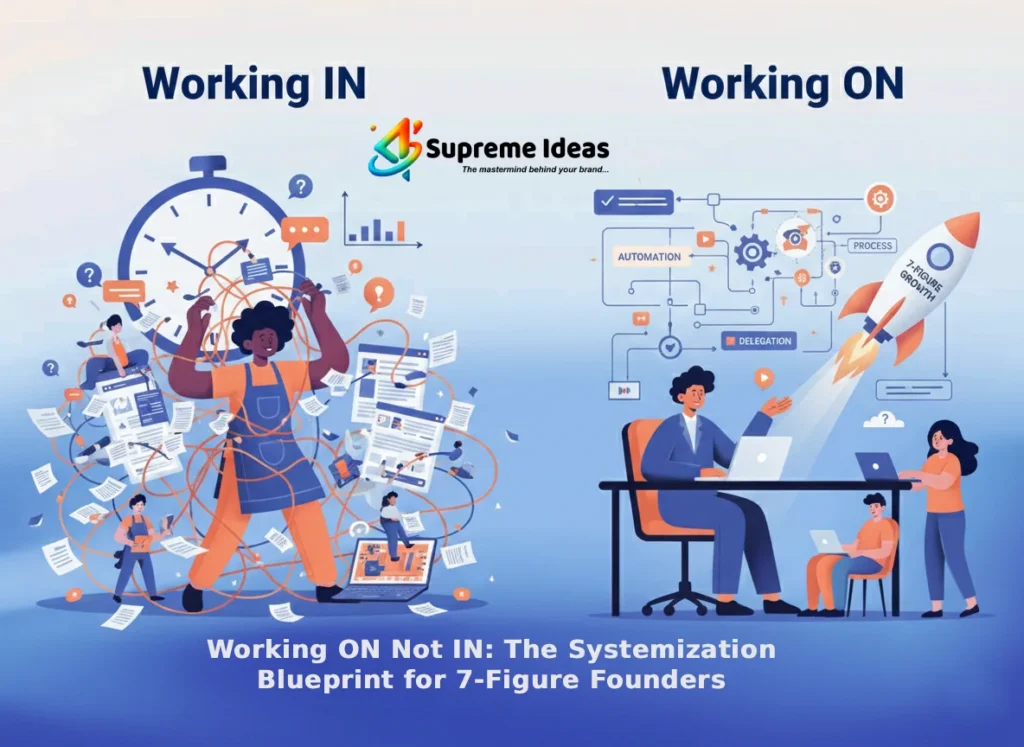
There is a very specific, quiet kind of hell that you enter when your business crosses the million-dollar revenue mark.
from the outside, everything looks perfect. you hit the seven-figure milestone. you updated your twitter bio. your friends from college think you are rich, and your parents finally stopped asking when you are going to get a “real” job. you won the startup game.
but on the inside? you are drowning.
you wake up at 5:30 AM in a cold sweat because you remembered an email you forgot to send to your biggest client. your slack notifications are going off like a slot machine. your “team” of five people is constantly pinging you with questions that you have answered a dozen times. you spend your entire day putting out fires, fixing other people’s mistakes, and apologizing for missed deadlines. you look up at 7:00 PM, the office is dark, your coffee is cold, and you realize you haven’t done a single piece of strategic, needle-moving work all day.
you didn’t build a business. you built a prison. and you are the warden, the guard, and the inmate all at once.
most founders hit this wall and they think the solution is to just work harder. they think if they can just squeeze two more hours out of the day, or drink a little more espresso, or find some new “productivity hack,” they will finally catch up.
lol. you will never catch up. the math is fundamentally against you.
the phrase “working ON your business, not IN your business” was popularized by Michael Gerber decades ago, but it has become a hollow cliché. people quote it on linkedin with a sunset background, but nobody actually tells you the brutal, mechanical steps required to extract yourself from the day-to-day operations without the whole thing collapsing into a pile of ash.
this is the definitive, no-fluff, exhaustive blueprint for systemizing a seven-figure business. we are going to tear down the psychological ego traps that keep you stuck in the weeds. we are going to look at the exact architecture of an unshakeable standard operating procedure (SOP). we are going to build communication matrices, delegation frameworks, and executive dashboards.
we are going to take the chaotic, founder-dependent hustle you are currently running and turn it into a boring, predictable, highly profitable machine that prints money whether you open your laptop today or not.
if you don’t get this right, you will eventually burn out, hate the company you built, and either shut it down or sell it for pennies just to make the pain stop.
let’s build the machine.
The Founder’s Ego Trap: Why We Sabotage Our Own Freedom
before we can build a single system, we have to address the elephant in the room. the reason your business is completely dependent on you is not because your team is incompetent. it is not because your industry is “too unique” to systemize.
it is because, on a deep, subconscious psychological level, you like it this way.
The Addiction to the Cape
when you started this business, you were the hero. you wore all the hats. you closed the deals, you wrote the code, you did the marketing, and you swept the floors. every time a crisis happened, you swooped in, put out the fire, and saved the day.
that feels good. it releases dopamine. being the “savior” of your own company makes you feel indispensable. it strokes your ego.
but as the company scales, that exact same hero complex becomes the ultimate bottleneck. if every decision has to pass through your brain, the company can only grow as fast as your cognitive bandwidth allows. and your bandwidth is already maxed out.
-
What most people misunderstand: Founders think they are stuck in the weeds because they “care more” than their employees. They think their constant meddling is a sign of high standards.
-
The Reality: Your constant meddling is a sign of poor leadership. If you have to step in and fix the work, it means you either hired the wrong person, or you failed to build a system that trains the right person.
The “Nobody Can Do It As Well As Me” Delusion
this is the most common objection i hear when i tell founders to systemize. “i can’t delegate the client strategy. my clients pay for my brain. nobody else can do it the way i do it.”
i beleive you. you probably are the best at it. but here is the cold, mathematical truth:
if you demand that every task be done at 100% of your personal standard of excellence, you will be trapped in that task forever. you have to embrace the 80% Rule of Delegation.
if an employee, armed with a good system, can do a task 80% as well as you can… you must delegate it immediately.
why? because 80% done by someone else is infinitely more scalable than 100% done by you. your clients will not notice the 20% drop in your “artisan touch” as long as the core result is delivered on time and solves their bleeding neck problem. and more importantly, that employee will eventually get to 90%, and then 95%, as they repeat the system.
-
The Bad Approach: Hoarding the high-leverage tasks because you don’t trust anyone else, resulting in you being the bottleneck that delays client delivery by three weeks.
-
The Good Approach: Building a framework that allows a junior employee to execute the task to an 80% standard within 48 hours, freeing you to focus on acquiring three new clients.
you have to kill the hero. you have to stop wanting to be the smartest person in the room, and start wanting to be the architect of the room.
The Anatomy of a True System (It’s Not Just Software)
when i say the word “system,” most founders immediately think of software. they think of Zapier, or Salesforce, or some complex Monday.com board with seventy colored tags. they think if they just buy the right $99/month SaaS tool, their business will magically organize itself.
software is not a system. software is a tool that accelerates a system. if you automate a broken, chaotic process, you just get broken, chaotic results at a much faster speed.
Defining the Concept
a true business system is a predictable, repeatable sequence of steps that produces a consistent outcome, regardless of who is executing it.
a system has four non-negotiable pillars. if you are missing even one of these pillars, you do not have a system; you have a wish.
1. The Trigger: What initiates the system? It cannot be “whenever we remember to do it.” It must be a binary event. Example: The trigger for the “Client Onboarding System” is the exact moment the Stripe payment clears. Not when the sales call ends, not when the contract is sent. The payment clearing is the absolute trigger.
2. The Sequence (The Steps): What happens next, in what exact chronological order? This must be documented so simply that a high school student could follow it without asking clarifying questions.
3. The Output (The Standard of Done): What does the finished product look like? You cannot systemize something if “done” is subjective. Example: “Done” is not “the client feels welcomed.” “Done” is “the client has received their welcome portal login, the kickoff call is scheduled on the calendar, and the internal slack channel is created with all stakeholders invited.”
4. The Feedback Loop (The Quality Check): How do we know the system worked without the founder having to manually check every single one? There must be an automated reporting mechanism or a peer-review step built into the sequence.
Real-World Scenario: The Content Factory
let’s contrast a chaotic process with a systemized process.
-
The Chaotic Approach (Working IN): You run a marketing agency. A client needs a blog post. You ping your freelance writer on Slack: “Hey, we need a post for Client X about real estate trends. Make it good.” The writer sends it back three days later. You read it. You hate it. You spend two hours rewriting it. You send it to the client. The client asks for revisions. You do the revisions yourself because it’s faster. You lost money on this task.
-
The Systemized Approach (Working ON): * Trigger: Client onboarding form is submitted with their monthly content pillars.
-
Sequence: The project manager creates a Trello card. The card contains a link to the “Brand Voice Guideline” specific to that client. The writer has a template that requires 3 H2 headers, 2 internal links, and a specific call to action.
-
Output: A 1,000-word draft formatted in a Google Doc.
-
Feedback Loop: The draft goes to an editor (not the founder) who runs it through a 5-point checklist. If it fails the checklist, it goes back to the writer. If it passes, it goes to the client.
-
in the second scenario, the founder never touched the blog post. the founder built the machine, and the machine built the blog post. that is how you scale to seven figures without losing your mind.
The Time and Friction Audit: Finding the Invisible Leaks
you cannot systemize your business until you know exactly where the business is currently bleeding.
most founders have a completely distorted perception of how they spend their time. if you ask a founder what they did all week, they will say, “i worked on strategy, i closed some big deals, and i managed the team.”
if you look at their actual browser history and slack logs, they spent 40% of their week formatting spreadsheets, answering low-level client emails, hunting for lost passwords, and trying to fix a bug on the wordpress site.
you are leaking equity value every single hour of the day. to stop it, we have to run a brutal time audit.
The $1,000/Hour Rule
before we start tracking time, we need to establish your baseline value. if you run a 7-figure company, your time is mathematically worth somewhere between $500 and $1,000 an hour.
i want you to write that number on a post-it note and stick it to your monitor. “$1,000 / Hour.”
now, every time you do a task, i want you to look at that post-it note and ask yourself: “Would i pay someone $1,000 an hour to do what i am doing right now?”
if you are sitting there resetting a client’s password, you are paying a $1,000/hr executive to do a $15/hr administrative task. it is financial malpractice. you are actively stealing from your own company’s profitability.
How to Run the Two-Week Friction Audit
you are going to hate this. everyone hates this. (no, really, i tried this with my own team and they complained for days, but it changed everything).
for the next 14 days, you are going to use a time-tracking tool like Toggl, or just a simple notepad on your desk. you are going to track every single thing you do in 15-minute increments.
you must be brutally honest.
-
9:00 AM – 9:15 AM: Reading industry newsletters.
-
9:15 AM – 10:00 AM: Rewriting a proposal that my sales guy messed up.
-
10:00 AM – 10:30 AM: Searching my inbox for a contract attachment from last month.
after 14 days, you take this data and you categorize it into four buckets:
-
High-Leverage (Founder Only): Sales calls with massive clients, high-level product architecture, hiring executives.
-
Mid-Leverage (Delegatable): Writing standard copy, running weekly team meetings, basic client strategy.
-
Low-Leverage (Automatable/Outsourceable): Data entry, inbox triage, scheduling calendar appointments, sending invoices.
-
Friction (Process Failure): Fixing mistakes, answering “where is this file?” questions, putting out fires caused by a lack of clarity.
The Insight
when founders do this, they almost always find that 60% to 80% of their time is spent in buckets 3 and 4.
you now have a physical map of your bottlenecks. you do not systemize the whole business at once. you look at the Friction bucket first. what is the one recurring mistake that cost you the most hours over the last two weeks?
that is the first system you build.
The Delegation Matrix: Drop, Delegate, Defer, Do
once you have your time audit, you will have a massive list of tasks that you should not be doing. the next step is the extraction process.
we use the 4 D’s framework, but we apply it with extreme prejudice.
1. Drop (Elimination before Automation)
the biggest mistake people make in systemization is trying to automate a process that shouldn’t exist in the first place.
as businesses grow, they accumulate “ghost processes.” things you started doing three years ago because a client asked for it once, and now your team just does it every week out of habit, even though nobody looks at the output.
-
Example: Generating a 15-page weekly analytics report for a client who only ever asks “how many leads did we get?”
-
The Fix: Stop generating the report. See if the client complains. If they don’t, you just “systemized” five hours of work out of existence by deleting it.
ruthless elimination is the highest form of systemization.
2. Delegate (The Transfer of Ownership)
if a task must be done, and it is not a $1,000/hr task, it must be delegated.
but delegation is where most founders fail spectacularly. they practice “Abdication,” not delegation. abdication is throwing a task over the fence to a junior employee, saying “figure this out,” and then getting angry when it’s done wrong.
true delegation requires the transfer of ownership, not just the transfer of labor. when you delegate, you must define the standard of done (as discussed in the anatomy of a system). you must give them the resources to do it, and you must give them the authority to make decisions within the boundaries of that task.
-
The Bad Approach: “Can you manage my inbox and let me know if anything important comes in?” (Vague, subjective, guarantees failure).
-
The Good Approach: “I need you to triage my inbox twice a day at 10 AM and 4 PM. Archive all newsletters. If a client emails a support question, forward it to the support desk and reply to the client saying it’s being handled. If a new lead emails, flag it red and text me. Do not touch anything from our accountant.” (Specific, binary rules, guarantees success).
3. Defer (The Parking Lot)
some things are good ideas, but they are distractions from the core objective. if a task is high-leverage but not urgent (like launching a podcast for your brand), you defer it. you put it in a “Quarterly Parking Lot” document and you do not look at it again until the current quarter is over.
protecting your focus is a system in itself.
4. Do (The Founder’s Zone of Genius)
what is left? the 10% to 20% of tasks that only you can do.
these are the tasks that actually move the needle. setting the vision. closing the whales. recruiting A-players. building strategic partnerships.
when you clear the garbage out of your calendar, and you spend 30 hours a week purely in your Zone of Genius, your business will experience explosive, unconstrained growth.
Building Unbreakable SOPs (That Your Team Will Actually Use)
we have arrived at the tactical core of the blueprint. the Standard Operating Procedure.
the acronym SOP makes people want to fall asleep. they imagine a dusty, 40-page PDF written in corporate jargon that lives on a shared drive and hasn’t been updated since 2019. nobody reads it, nobody uses it, and it is completely worthless.
a modern, unbreakable SOP is not a document. it is a living multimedia training asset.
The “See, Do, Document” Protocol
you should almost never write your own SOPs from scratch. it is a waste of your $1,000/hr time.
instead, you use the “See, Do, Document” protocol with your team.
Step 1: See (The Loom Recording) the next time you do a task that needs to be systemized (let’s say, setting up a new client campaign in your software), you do not write out the steps. you open a screen recording tool like Loom.
you hit record, and you narrate exactly what you are doing, and more importantly, why you are doing it. “I am clicking this box because if we don’t, the billing won’t trigger. Now I am checking this drop-down, and here is a common edge-case where the data might look weird. If it looks like X, do Y.”
you finish the 10-minute video. you send the link to your employee.
Step 2: Do (The Employee Executes) the next time that task needs to be done, the employee watches the video and executes the task themselves.
they will inevitably run into a problem that you forgot to mention in the video. they will ping you. you answer their question, but you give them a crucial instruction: “Add that answer to the documentation.”
Step 3: Document (The Employee Writes the SOP) the employee is the one who writes the actual step-by-step checklist based on your video and their own experience of doing it.
they build a page in Notion (or your wiki tool of choice). the layout of a perfect SOP page:
-
The “Why”: One sentence explaining why this task matters to the company’s bottom line. (Context creates care).
-
The Video: The embedded Loom video of you doing it.
-
The Checklist: A 5-to-10 point bulleted list of the exact clicks and actions.
-
The Troubleshooting Matrix: An “If This, Then That” section for common errors. (e.g., “If the API fails, check this token first”).
The Rule of the Living Document
an SOP is never “finished.” it is a living organism.
the rule in your company must be: “The system is the boss. If the system fails, we fix the system, we do not blame the person.”
if an employee makes a mistake, your first question as a founder is never “why did you mess this up?” your first question is, “did you follow the SOP?” if they say yes, and the outcome was still bad, it means your SOP is broken. you and the employee go into the Notion document and you fix the broken step immediately.
if they say no, they didn’t follow the SOP, then it is a management issue. but 9 times out of 10, the system is what failed.
when you make the employees the authors and editors of the SOPs, they take ownership of the systems. you transition from a “top-down dictatorship” to a “system-driven culture.”
Hiring for Systems: The Visionary vs. The Integrator
you can build all the SOPs in the world, but if you put the wrong psychological profile in charge of executing them, the business will still chaotic.
this is where we have to talk about the dynamic popularized by the EOS (Entrepreneurial Operating System) framework: The Visionary and The Integrator.
The Visionary (That’s You)
as the founder, you are almost certainly a Visionary. you love starting things. you love big ideas. you love closing deals. you operate at 30,000 feet.
but visionaries have a fatal flaw: they get bored easily.
you hate the details. you hate doing the same thing twice. you hate maintenance. if you are forced to run the day-to-day operations of your own systems, you will subconsciously break them just to create some exciting chaos to fix. (yes i know that sounds dramatic—whatever. it is a documented psychological pattern among entrepreneurs).
The Integrator (The Operator)
to scale to seven figures and beyond without losing your sanity, you must eventually hire an Integrator. this is your Chief Operating Officer (COO), your Director of Operations, or your General Manager.
the Integrator is a completely different breed of human. they love checklists. they love spreadsheets. they get a dopamine hit from taking a chaotic, messy idea from the Visionary and turning it into a neat, chronological system. they love finishing things. they thrive on predictability.
How to Interview an Operator
most founders hire people who are just like them. they hire other visionaries because they “click” in the interview. two visionaries running a company is a recipe for massive revenue and zero profit, ending in a fiery explosion of undelivered promises.
you need to hire someone who slightly annoys you with their demand for detail.
-
The Bad Interview Question: “Where do you see the future of this industry going?” (You don’t care about their industry vision. You are the vision).
-
The Good Interview Question: “Walk me through how you would organize a 500-person digital summit if I gave you the project today.”
listen to their answer. if they start talking about the “vibe” of the summit and the cool speakers they would get… they are a visionary. do not hire them for operations. if they immediately pull out a notepad, ask what the budget is, ask what project management software we use, and start outlining a 12-week critical path timeline… hire them immediately.
once you have an Integrator, your job is to stay out of their way. you hand them the destination, and you let them build the tracks to get there.
The Communication Architecture: Killing the “Got a Sec?” Culture
one of the most insidious ways a system breaks down is through ad-hoc communication.
if your business runs on people tapping you on the shoulder, calling your cell phone randomly, or sending you slack messages that start with “hey, got a sec?”… you do not have a business. you have a highly reactive group chat.
we must systematize how information flows through the company.
Asynchronous vs. Synchronous Communication
the vast majority of communication in a systemized business must be asynchronous (async). meaning, i send you a message, and i do not expect an immediate reply. i expect a reply within a defined SLA (Service Level Agreement), usually 4 to 24 hours.
synchronous communication (sync) is real-time. Zoom calls, phone calls, walking over to someone’s desk. sync communication should be fiercely protected and used only for complex problem-solving, emotional conversations, or true emergencies.
-
The Problem: Founders treat Slack like synchronous communication. They expect their team to reply within 30 seconds. This forces the team to keep Slack open all day, constantly monitoring it, which destroys their ability to do deep, focused work.
-
The System: Establish communication rules.
-
Email: For external client communication. Expected reply: 24 hours.
-
Project Management (Asana/Trello): For all task-related updates. If it is about a project, it lives in the project card, nowhere else.
-
Slack: For async internal chat. Expected reply: 4 hours.
-
Text/Phone Call: For absolute, literal emergencies only (the server is down, the website is hacked).
-
when you define these lanes, the “got a sec?” culture dies. people learn to batch their questions and put them in the appropriate channel.
The Level 10 Meeting Cadence
systemized companies do not have “status update” meetings. status updates can be read on a dashboard. meetings are expensive, synchronous events that must be used exclusively for solving bottlenecks.
adopt a strict weekly meeting cadence. the gold standard is the Level 10 meeting (another EOS concept).
it happens on the same day, at the exact same time, every single week. it starts on time and ends on time.
-
First 5 minutes: Good news (personal and business).
-
5 minutes: Reviewing the scorecard (metrics only, no discussion).
-
5 minutes: Reviewing quarterly goals (on track or off track).
-
5 minutes: Customer/Employee headlines (quick updates).
-
5 minutes: To-do list review from last week.
-
The Core (60 minutes): IDS (Identify, Discuss, Solve).
the IDS section is where the magic happens. throughout the week, anytime an employee has a non-urgent problem, instead of pinging you on Slack, they add it to the IDS agenda.
during the meeting, you look at the list of issues, rank them by priority, and then you spend 60 minutes solving the root cause of the biggest problems. you do not just put a band-aid on it; you build or fix an SOP so the problem never hits the IDS list again.
this one meeting replaces dozens of scattered, reactive conversations throughout the week.
Financial and Metric Systemization: Dashboards Over Gut Feelings
you cannot manage what you do not measure. and you cannot measure a business based on your “gut feeling.”
i see 7-figure founders who literally run their business by looking at their bank account balance once a week. if the number is high, they spend money. if the number is low, they yell at the sales team.
this is driving a race car while looking in the rearview mirror. your bank account is a lagging indicator. it tells you what happened 30 days ago. you need leading indicators. you need an executive dashboard.
Leading vs. Lagging Indicators
-
Lagging Indicators: Revenue, Profit, Churn Rate. These are the results of the system. By the time you see them, it is too late to change them.
-
Leading Indicators: Number of outbound sales calls made, website traffic, number of support tickets opened, ad click-through rate. These are the inputs of the system. They predict the future.
if you know that historically, every 100 outbound sales calls results in 10 demos, and 10 demos results in 2 closed deals worth $10,000… then your leading indicator is outbound calls.
if you check your dashboard on a Wednesday and see that only 20 calls have been made, you do not have to wait until the end of the month to know revenue will be down. you know right now. and you can intervene right now.
Building the Executive Scorecard
you must build a systemized scorecard that is updated automatically, or updated by a junior employee, every single Friday.
it should contain no more than 10 to 15 key metrics. if you have 50 metrics, you have data vomit, and you will ignore it.
-
Sales/Marketing Metrics: Leads generated, CAC (Customer Acquisition Cost), Demos booked, Close rate.
-
Operational Metrics: Average ticket resolution time, Project delivery on-time percentage, Utilization rate.
-
Financial Metrics: Cash in bank, Accounts Receivable (who owes us money), MRR (Monthly Recurring Revenue).
as the founder working ON the business, your job is to sit down on Monday morning with a cup of coffee, look at the scorecard, and instantly know the health of the entire machine.
if a number is red (off-track), you do not dive into the weeds and fix it yourself. you go to the operator or department head in charge of that number, and you ask them: “The lead metric is red this week. What is the plan to get it back to green?”
you manage the numbers, and the team manages the work.
The Ultimate Stress Test: The 30-Day Disappearance Rule
we have built the psychological framework, the SOPs, the communication architecture, and the dashboards.
how do you know if it actually works? you have to test the machine. and the only way to test the machine is to unplug the founder.
The Progressive Detachment Method
you cannot just walk away tomorrow. you will induce panic. you must detach progressively.
Phase 1: The 24-Hour Blackout Pick one day next week. Do not log into email. Do not open Slack. Do not take any calls. The next morning, see what broke. Whatever broke is where your systems are weakest. Fix those specific SOPs.
Phase 2: The One-Week Vacation (No Laptop) Take a five-day vacation. Leave your laptop at home. Give your Integrator your phone number for absolute, existential emergencies only (define what an emergency is: the building is on fire, or we are being sued). When you come back, review the scorecard. Did the business still generate leads? Did clients still get serviced?
Phase 3: The 30-Day Disappearance This is the holy grail of systemization. You leave the business for a full month. You empower your leadership team to make financial decisions up to a certain threshold without your approval. You empower them to hire and fire junior staff.
if you can leave your business for 30 days, and you return to find that revenue stayed flat or grew, clients are happy, and the team didn’t burn the building down… congratulations.
you no longer own a job. you own an asset.
you have successfully built a machine that operates independently of your daily labor. the value of a business that can run without its founder is exponentially higher than the value of a founder-dependent hustle, even if the revenue is the exact same. buyers pay massive multiples for systemized cash flow. they pay nothing for a glorified freelance operation.
Conclusion: The Shift in Identity
working ON your business, rather than IN it, is not a series of software upgrades. it is a fundamental, sometimes painful shift in your identity as an entrepreneur.
you have to mourn the loss of the “hero” founder. you have to stop deriving your self-worth from how many fires you put out before lunch. you have to stop equating exhaustion with productivity.
you are transitioning from a maker, to a manager, to an architect.
an architect does not pour the concrete. an architect does not swing the hammer. an architect designs a flawless blueprint, ensures the physics and mathematics are sound, hires the best foremen, and watches the building rise from the ground.
the transition is messy. your first SOPs will suck. your team will resist the new communication rules. you will be tempted, daily, to dive back into the weeds and just “do it yourself because it’s faster.”
do not give in to that temptation.
every time you do a $15/hr task, you are stealing from your own future. every time you fix a mistake instead of fixing the system that caused the mistake, you are ensuring that the mistake will happen again next week.
embrace the boring work of systemization. write the checklists. record the loom videos. build the scorecards.
the reward for this boring, tedious work is the ultimate prize in the capitalist ecosystem: absolute freedom.
freedom to scale the company to eight figures without working weekends. freedom to sell the company for a massive multiple. or simply, the freedom to log off at 3:00 PM on a Tuesday, go for a walk, and know with absolute certainty that the machine is humming perfectly in your absence.
…anyway, close your inbox. go write your first SOP. the machine won’t build itself.