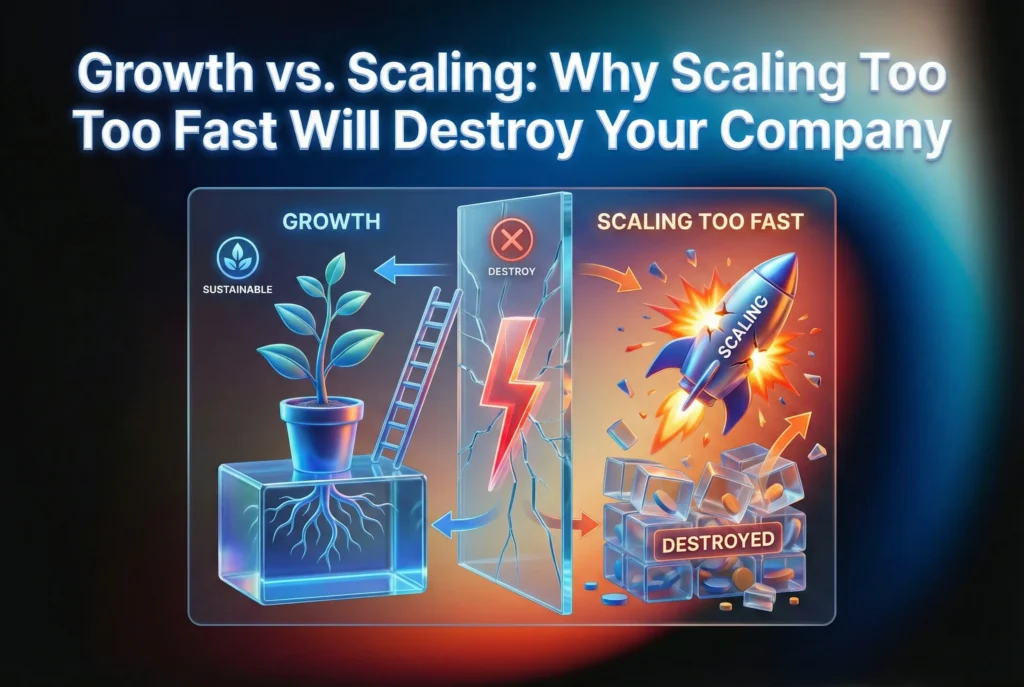
We need to talk about the most dangerous word in the startup dictionary. if you go to any networking event, any pitch competition, or any tech incubator, you will hear this word thrown around like confetti. “we’re getting ready to scale.” “our biggest problem right now is scaling.” “we need a mentor who has scaled to eight figures.”
everybody wants to scale. nobody wants to just “grow.” growth sounds boring. growth sounds like something a local bakery does. scaling sounds like silicon valley. scaling sounds like private jets and techcrunch articles.
but here is the brutal reality that nobody tells you on those motivational podcasts: more startups die of indigestion than starvation.
they don’t die because they couldn’t find any customers. they die because they found too many customers, too fast, using a broken operational model, and the entire business collapsed under its own weight. they tried to put rocket fuel into a honda civic, and the engine exploded. (no, really, i have watched companies go from a million in the bank to bankrupt in six months because they decided to “scale” a leaky funnel).
the problem is that founders use the words “growth” and “scaling” interchangeably. they think they mean the exact same thing. they don’t. they are fundamentally different economic and operational models. if you try to scale a business that is only built to grow, you will destroy your brand, burn out your team, and incinerate your cash reserves.
this is the definitive guide to understanding the mechanics of expansion. we are going to look at the exact mathematical difference between growth and scaling, why premature scaling is the number one cause of startup death, and how to build the unshakeable infrastructure required to actually turn the firehose on without drowning your own company.
if you don’t get this right, success will literally kill you.
The Core Definition: Adding Weight vs. Adding Leverage
to stop the bleeding, we have to define the terms. the reason founders screw this up is that they look at top-line revenue as the only metric of expansion. “we went from $10k a month to $50k a month! we scaled!”
no, you didn’t. you grew. and there is a massive difference in how that $50k was achieved.
What is Growth? (The Linear Path)
growth is linear. it means that for every dollar of revenue you add to the business, you have to add an equivalent amount of resources (time, capital, or human labor).
if you run a traditional marketing agency and you get five new clients, your revenue goes up. but to service those five clients, you have to hire a new account manager. if you get ten more clients, you have to hire two more account managers. your revenue is going up, but your costs are going up at the exact same angle.
growth is trading resources for revenue at a relatively fixed ratio.
-
The Good Approach to Growth: Accepting that you are a linear business and optimizing for profit margin. You build an incredibly healthy, slow-growing agency that throws off massive cash for the founder.
-
The Bad Approach to Growth: Pretending you are a tech company and trying to “scale” your agency by pouring $50k into ads, signing 40 clients in a month, and then realizing you have literally no humans to do the work. The clients churn, they leave 1-star reviews, and your brand is dead.
What is Scaling? (The Exponential Path)
scaling is exponential. it is the decoupling of revenue from resources. scaling means that revenue goes up dramatically, but costs only go up incrementally.
software is the classic example of a scalable business. if you build a SaaS product, it costs you $100,000 to write the code. but once the code is written, the cost to deliver that software to one user is exactly the same as the cost to deliver it to ten thousand users. your server costs might go up slightly, but you don’t have to hire 10,000 developers.
you add revenue without adding proportional weight.
-
The Misconception: Founders beleive that if they just get more customers, the business will naturally scale. it won’t. if your delivery mechanism requires manual human labor, you cannot scale. you can only grow. and if you force growth too fast, you break the humans.
Premature Scaling: The Ultimate Startup Killer
there is a widely cited study by the Startup Genome Project that analyzed over 3,000 tech startups. they found that 74% of high-growth internet startups fail because of one specific reason: premature scaling.
what does that actually mean?
premature scaling is when a founder steps on the gas pedal before the engine is actually built. it is spending money on marketing, hiring, and expansion before you have achieved true product-market fit, and before your unit economics actually make mathematical sense.
The Illusion of Product-Market Fit
most founders think they have product-market fit because their mom bought the product, and three guys from a facebook group bought the product. they get 10 early adopters and they immediately think, “holy crap, everybody wants this. let’s raise a million dollars and run super bowl ads.”
but those 10 early adopters are outliers. they are the people who are so desperate for a solution that they are willing to put up with your buggy software and your terrible customer service.
when you try to scale that buggy experience to the mass market, the mass market rejects it. the mass market does not have patience.
-
The Bad Approach: A founder gets 50 beta users. They immediately hire a VP of Sales for $150k a year, buy a massive booth at an industry conference, and dump $20k into LinkedIn ads. The traffic comes in, the product crashes, the VP of Sales gets frustrated and quits, and the company runs out of money.
-
The Good Approach: A founder gets 50 beta users. They turn off all marketing. They spend the next 90 days interviewing those 50 users, fixing every single bug, refining the onboarding process, and ensuring that 45 out of those 50 users actually achieve the promised result. Only then do they turn the marketing back on.
Scaling a Negative Margin (The Sunk Cost Trap)
this is where the math gets brutal.
if you are losing money on every customer you acquire, scaling will just bankrupt you faster.
let’s say it costs you $100 in ad spend to acquire a customer (CAC). the customer only pays you $80 over their lifetime (LTV). your unit economics are broken. you are losing $20 per customer.
a shocking number of founders look at this math and say, “we just need economies of scale. if we get 10,000 customers, our brand awareness will be so high that our ad costs will drop.”
lol. no they won’t. ad platforms don’t give you a discount because you’re famous. they charge what the market bears. if you scale a broken unit economic model to 10,000 customers, you don’t magically become profitable. you just lose $200,000.
you must fix the math at the micro level before you apply it to the macro level. if it doesn’t work for one customer, it will fundamentally destroy you at a thousand customers.
The Operational Black Hole: What Breaks When You Speed Up
when you force a company to scale before it’s ready, the failure isn’t usually a spectacular explosion. it is a slow, agonizing descent into an operational black hole.
the founder is usually completely blind to this. they are looking at the Stripe dashboard, watching the revenue line go up, and giving each other high-fives. meanwhile, in the trenches of the business, everything is catching on fire.
The Customer Support Collapse
this is always the first thing to break.
when you have 100 customers, a 5% error rate means 5 people have a problem. you can personally email those 5 people, apologize, jump on a Zoom call, and fix it. you think your customer service is “world-class.”
when you scale to 10,000 customers in a month, that same 5% error rate means 500 people have a problem. you cannot jump on 500 Zoom calls. your inbox floods. your one support rep quits because they are getting yelled at for eight hours a day. the tickets pile up.
because the tickets pile up, the customers get angry. they go to Twitter. they go to Trustpilot. they leave blistering 1-star reviews.
-
The Reality Check: Your new prospects look at those 1-star reviews and decide not to buy. Your acquisition costs skyrocket because your brand trust is destroyed. You scaled the revenue, but you broke the fulfillment, which ultimately killed the future revenue.
The Cultural Dilution (The “Who Hired This Guy?” Problem)
to support the rapid influx of customers, you have to hire fast.
when you are growing slowly, you interview every candidate. you test them. you make sure they fit the exact culture and standard of excellence you demand.
when you are scaling too fast, you panic-hire. you just need warm bodies to answer the phones and process the orders. you hire an HR agency to recruit 20 people in a week. you don’t train them properly because you “don’t have time.”
within thirty days, the culture of your company is unrecognizable. the new hires don’t care about the mission; they just want a paycheck. they treat the customers poorly. your original “A-players” get frustrated by the incompetence around them, and they quit.
you traded your elite core team for an army of mediocrity, all in the name of “scaling.”
The Prerequisites for Scaling: Building the Moat
if you want to avoid the black hole, you have to earn the right to scale. scaling is a privilege, not a default setting.
before you pour gasoline on the fire, you have to ensure the fireplace is made of brick, not cardboard. there are three specific prerequisites you must have in place. if you are missing even one of them, keep your foot off the gas.
1. Unshakeable Standard Operating Procedures (SOPs)
we talked about this in previous guides, but it becomes a matter of life and death here.
if the knowledge of how to run the business lives entirely in the founder’s head, the business cannot scale. the founder is the bottleneck. if every time a weird edge-case happens, an employee has to ping you on Slack to ask what to do, you will die of a thousand notifications when you 10x the customer base.
-
The Bad Approach: “We’re a dynamic startup! We don’t like corporate red tape. We just figure it out on the fly.” (This works for 10 clients. It causes a lawsuit at 1,000 clients).
-
The Good Approach: Every single repetitive action in the company is documented. How to process a refund. How to onboard a new hire. How to reset a server. A stranger should be able to walk in off the street, read your internal wiki, and run 80% of your business without asking a single question.
if you don’t have SOPs, you aren’t ready to scale. you are just preparing to scale the chaos.
2. Predictable, Profitable Acquisition Channels
you cannot scale a business based on viral luck or founder hustle.
if your current customers came from you going on a popular podcast, or a random tweet that went viral, you do not have a scalable acquisition channel. you cannot predict when you will go viral again.
scaling requires a vending machine mentality. you must know, with absolute mathematical certainty, that if you put $1.00 into a specific machine (like Facebook ads, or cold email outreach, or SEO), you will get $3.00 back out.
you must know your Customer Acquisition Cost (CAC) and your Lifetime Value (LTV). if you don’t have a reliable, dial-able channel that converts strangers into profitable customers on demand, you cannot scale. you are just hoping to get lucky twice.
3. Decoupled Delivery (The Capacity Check)
this is the true test of scalability.
ask yourself: “If we received 1,000 new orders tomorrow morning, what would break?”
if the answer is “everything,” you have an agency or a hustle, not a scalable startup. you have to decouple the delivery of the value from human hours.
if you run a consulting firm, you cannot scale by just doing more 1-on-1 calls. you have to build a group coaching model, or a recorded curriculum, or a software tool that does the heavy lifting.
you must build a system where the capacity to deliver is virtually infinite, even if the team size stays the same.
The Ego Trap: Why Founders Ignore the Math
if the math is so clear, and the risks are so high, why do so many smart founders drive their companies right off the cliff?
because scaling is an ego drug.
we operate in an ecosystem that worships top-line revenue and headcount. if you go to a dinner party and tell people you run a highly profitable, $500k-a-year business with zero employees, they look at you like a freelancer. if you tell them you just raised $5 million and hired 40 people (even if you are burning cash and sleeping three hours a night), they look at you like a visionary.
founders scale to impress other founders.
The Venture Capital Pressure Cooker
the other major factor is outside money. when you take venture capital, you are no longer in the business of building a sustainable company. you are in the business of building a financial instrument that must return a 10x to 100x multiple for the fund.
VCs do not care about your slow, profitable growth. they operate on a portfolio model. they know that 8 out of 10 startups in their portfolio will die. they just need the other 2 to become billion-dollar unicorns to cover the losses.
so they hand you a massive check and they tell you to blitzscale. “capture the market! grow at all costs! worry about profit later!”
-
The Reality: For the VC, this is a calculated risk across a spreadsheet of fifty companies. For you, this is your life. If you blitzscale and the company implodes, the VC writes it off as a tax loss and goes to the Hamptons. You lose your company, your reputation, and your sanity.
i mean—it’s intresting how many founders take VC money without realizing they just sold their right to build a sane, stable business. if you don’t want to scale at a breakneck, dangerous speed, do not take the money. bootstrap it. own the equity. set the pace.
Real-World Scenario: The Agency That Imploded
let’s look at exactly how this plays out in the wild. this is a composite of dozens of agencies i have watched die.
Month 1 to 6: The Golden Era Founder A starts a boutique Facebook Ads agency. They have 5 clients paying $3,000 a month. The founder does all the media buying, writes the copy, and handles the client calls. The results are amazing because the founder is a genius. The clients love them. The profit margin is 80%. Life is great.
Month 7: The Ego Decision Founder A sees a competitor bragging on LinkedIn about hitting $100k MRR. Founder A’s ego flares up. “If that idiot can do it, i can do it.” Founder A decides it is time to “scale.”
Month 8: The Firehose Founder A hires a lead generation firm to blast cold emails. They drop $10k on ads. Suddenly, they have 20 new clients. Revenue spikes to $75k MRR. Founder A feels like a god.
Month 9: The Cracks Appear Founder A cannot physically run ads for 25 clients. They panic-hire three junior media buyers who have barely managed a budget before. There are no SOPs, so Founder A has to train them verbally between sales calls.
Month 10: The Delivery Fails The junior media buyers mess up the ad accounts. ROAS plummets. The original 5 clients—the ones who built the company—notice the drop in quality. They complain. Founder A is too busy doing sales calls to fix the ad accounts.
Month 11: The Black Hole The clients realize they are paying premium prices for junior-level work. The churn starts. 10 clients leave in one week. Revenue drops from $75k to $45k. But Founder A now has a lease on an office, three salaries to pay, and a contract with the lead gen firm. The overhead is $50k. The business is now losing $5k a month.
Month 12: The Collapse Founder A tries to micromanage the team to fix the results. The team gets resentful and quits. Founder A is left with 10 angry clients, zero team, a broken reputation, and negative cash flow.
they tried to scale an un-systematized agency, and it destroyed the $15k/month profit machine they originally had.
How to Actually Expand: The Throttle Method
so, how do you grow without blowing up the engine? you use the Throttle Method.
you do not view expansion as a light switch that you flip from “off” to “on.” you view it as a dial.
Step 1: Secure the Base
before you touch the dial, you ensure the current base of customers is utterly thrilled. your churn rate must be virtually zero. your profit margin must be fat enough to absorb shocks. your team must be bored because the SOPs work so perfectly.
Step 2: Turn the Dial 10%
you do not try to double your revenue in a month. you increase your marketing spend just enough to add 10% more volume to the system.
Step 3: Watch for the Smoke
you let that 10% hit the system, and you sit back and watch. what breaks? did the onboarding software glitch? did the support inbox backup by four hours? did the sales team start dropping follow-ups?
every system has a breaking point. the throttle method allows you to find the breaking point while the damage is still small.
Step 4: Patch the Leak
you stop all marketing. you do not add another dollar of revenue. you go into the operations and you fix the thing that smoked. you upgrade the software, you refine the SOP, you hire the fractional assistant.
you reinforce the infrastructure until that extra 10% volume feels completely effortless.
Step 5: Turn the Dial Again
once the system is stable, you turn the dial another 10%. you repeat the process.
this is not sexy. this will not get you on the cover of Fast Company. this is slow, methodical, paranoid expansion. but this is how you build a fortress. the companies that scale successfully are the ones that treat operations with the same reverence that they treat sales.
Nuance: When Scaling Fast is Actually Required
i want to add a layer of nuance here so i don’t sound completely anti-scale.
there are very rare, specific situations where blitzscaling is actually the mathematically correct move.
if you are in a “winner-take-all” market—like ride-sharing (Uber/Lyft), or social networking (Facebook), or two-sided marketplaces (Airbnb)—the value of the network is the entire business. if you do not capture the market share immediately, your competitor will, and the market will lock you out forever.
in those incredibly rare instances, you have to raise the billion dollars, burn the cash, accept the operational chaos, and just try to survive the speed wobble until you achieve monopoly status.
but here is the truth: you are probably not building a winner-take-all marketplace. if you are building a B2B SaaS, a marketing agency, an e-commerce brand, or a consulting firm… there is no monopoly. there is plenty of room for a thousand successful companies in your space.
you do not need to blitzscale. you are choosing to blitzscale out of impatience, not necessity.
Common Objections and Reality Checks
when i tell founders to slow down their expansion, they usually fight back with the same three arguments.
“If i don’t scale fast, my competitors will steal my market share!” your competitors are probably dealing with the exact same operational nightmares that you are. if they scale too fast, their product will degrade, their customers will get angry, and those customers will leave and come looking for a stable, high-quality alternative.
let your competitors burn themselves out trying to be everything to everyone. you focus on being the absolute best solution for a smaller, highly profitable segment.
“But my investors are demanding 3x year-over-year growth.” this is the bed you made when you took the money. if you took VC money, you have to play the VC game.
but if you are bootstrapping, or if you took money from sane angel investors, you need to manage their expectations. you sit down with them and explain that forcing a 3x growth rate this year will destroy the LTV of the current cohort because the delivery systems will break. you show them that a 50% growth rate with a 95% retention rate yields a massively higher valuation in three years than a 300% growth rate with an 80% churn rate.
“I just want to get to $10M so i can exit and be done.” nobody buys a broken $10M company. when private equity firms or strategic buyers look at your company, they perform extreme due diligence. they don’t just look at the top line. they look at the churn, the tech debt, the reliance on the founder, and the profit margin.
if you scaled a mess to $10M, the buyer will see it. they will either walk away, or they will offer you a fraction of your valuation because they know they have to spend millions to fix the operational garbage you left behind.
you cannot exit a house of cards.
Conclusion: The Sanity of Controlled Expansion
at the end of the day, business is a marathon that is constantly disguised as a sprint.
the media, the gurus, and the startup ecosystem will scream at you to run faster. they will tell you that if you aren’t “crushing it” and doubling your headcount every six months, you are failing.
you have to learn to ignore the noise.
scaling is a magnificent, wealth-generating mechanism when it is applied to a stable, decoupled, highly profitable system. it is the holy grail of modern capitalism. but it is a weapon of mass destruction when applied to a fragile, founder-dependent hustle.
you have to be deeply, ruthlessly honest about what kind of business you currently have. if you are still fulfilling orders manually, you are not ready to scale. if you are still answering customer support emails at 11 PM, you are not ready to scale. if you lose money on the first transaction and hope to make it up in year two, you are definitely not ready to scale.
fix the leaks. build the SOPs. fire the bad clients. raise your prices. build a business that is so dense, so profitable, and so operationally boring that adding another zero to the revenue feels like an administrative afterthought, not a company-wide emergency.
…anyway, the firehose is tempting. just make sure you know how to swim before you turn it on.