Isee founders making the exact same fatal error over and over again. they look at their Stripe dashboard, they see the monthly recurring revenue going up, and they assume they are winning. they treat every single dollar that hits their bank account as a victory, regardless of how much blood, sweat, and panic it took to acquire that dollar.
this is a delusion. it’s the delusion of equality.
we desperately want to beleive that all clients are created equal, that all product lines contribute evenly to our success, and that more revenue automatically equals a healthier business. but the universe doesn’t work like that. the universe is wildly, aggressively disproportionate.
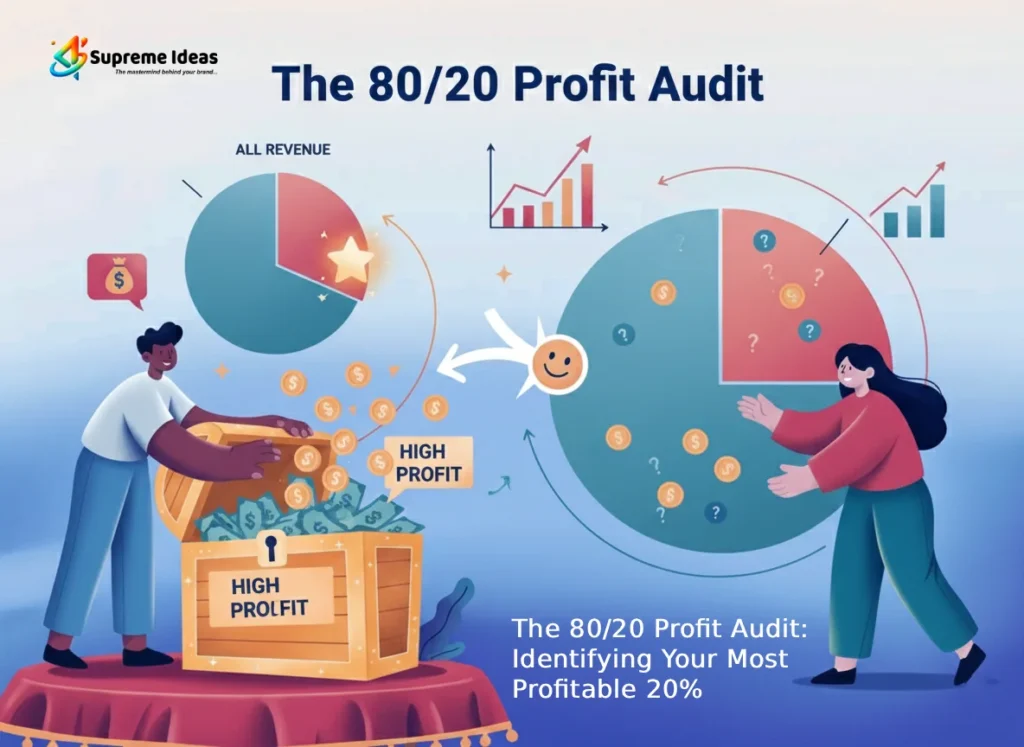
over a hundred years ago, an Italian economist named Vilfredo Pareto noticed that 80% of the land in Italy was owned by 20% of the population. he then looked at his garden and realized that 80% of the peas were produced by 20% of the peapods. this wasn’t just a quirk of italian real estate or gardening; it’s a fundamental law of nature and mathematics. the Pareto Principle dictates that a tiny minority of inputs produces the vast majority of outputs.
if you run a business, this law is currently operating inside your P&L statement whether you acknowledge it or not.
80% of your revenue comes from 20% of your clients. 80% of your customer support headaches come from a different 20% of your clients. and most importantly, 80% of your actual, take-home net profit is being generated by an incredibly small fraction of the work you do.
the problem is that most founders never actually sit down to figure out which 20% is carrying the company, and which 80% is slowly bleeding it to death. they just keep running on the treadmill, answering emails at midnight, wondering why they feel so exhausted while making “so much money.”
this is the definitive guide to the 80/20 Profit Audit. we are going to tear open your business, ignore the vanity metrics, and find the invisible profit centers. we will look at how to calculate the true cost of a client, the psychological barrier of firing people who pay you, and how to prune the dead branches so the trunk can finally grow.
if you do this right, you will probably cut your top-line revenue by 30%. and your take-home profit will double.
The Revenue vs. Profit Mirage: Why Top-Line 80/20 is a Trap
the biggest misconception about the 80/20 rule is how founders apply it. when a founder finally decides to analyze their business, they usually pull up a spreadsheet, sort their clients by “Total Revenue,” look at the top 20%, and say, “okay, these are my best clients.”
this is a catastrophic mistake.
you are conflating volume with value. just because someone pays you the most money does not mean they are making you the most profit. in fact, in the agency and B2B service world, the client who pays you the highest retainer is very often the one bankrupting you behind the scenes.
The Tale of the Vampire Client
let me give you a very common real-world scenario.
let’s say you run a marketing agency. Client A is a massive corporate account. They pay you $15,000 a month. They are your “whale.” You put their logo on your website. You brag about them at dinner parties. Client B is a quiet, boring local business. They pay you $2,500 a month. You barely think about them.
if you sort by revenue, Client A is your best client.
but let’s look at the actual mechanics of the fulfillment. Client A demands a custom weekly reporting call that takes three hours to prep for. They have a “marketing committee” of five people who all want to give revisions on every single ad graphic. They require you to use their proprietary enterprise software, which means you had to spend twenty hours training your team on a tool you will never use for anyone else. They text you on weekends. The “Cost of Goods Sold” (COGS)—which includes your team’s hourly rate, software, and your own founder time—comes out to $14,200 a month.
Your net profit on Client A is $800.
Now look at Client B. They pay $2,500 a month. They trust you. You use your standard templates. The ads run on autopilot. They only want one automated email report a month. They never call you. The total cost to service them is $300 in software and one hour of a junior media buyer’s time.
Your net profit on Client B is $2,200.
Client A brings in 6x the revenue of Client B, but Client B brings in almost 3x the profit. Client A is a vampire. They are sucking the operational bandwidth out of your company for pennies on the dollar, masking their drain with a big vanity number on your Stripe account.
if you only do a revenue audit, you will bend over backwards to keep Client A, and you will ignore Client B. the goal of the Profit Audit is to expose the vampires and find the sleepers.
The Mechanics of the Profit Audit: Building the Matrix
doing an 80/20 profit audit is not a fun afternoon. it is tedious, confronting, and mathematically ruthless. you cannot do this in your head. human beings are terrible at estimating their own efficiency. you have to build the matrix.
you need a spreadsheet. on the Y-axis, you list every single client, product line, or service offering you have active right now.
across the X-axis, we are going to create four specific columns. if you skip any of these, the audit fails.
Column 1: Gross Revenue
this is the easy part. how much cash did this specific client or product line bring into the business over the last trailing 12 months? if it’s a new client, annualize their current monthly run rate. write the number down. this is the vanity metric, but we need it as a baseline.
Column 2: Hard COGS (The Tangible Costs)
this is where most accountants stop. what are the hard, direct costs required to deliver this specific product or service? if it’s e-commerce, it’s the manufacturing, shipping, and direct ad spend for that specific SKU. if it’s a service business, it is the direct payroll cost of the employees doing the work for that specific client. if you pay a designer $40 an hour, and they spent 10 hours on Client A this month, that is $400 in hard COGS.
-
The Bad Approach: Allocating overhead evenly. You cannot just take your total software bill and divide it by the number of clients. If Client A requires you to use a specific $500/month API, that $500 goes directly into Client A’s COGS.
Column 3: Founder Time-COGS (The Hidden Bleed)
this is where the audit gets bloody.
most founders do not track their own time, and they certainly don’t attribute a cost to it. they treat their own time as “free” because they own the equity. this is why so many founders feel like they are drowning while their P&L says they are profitable. their P&L is lying, because it is being subsidized by the founder’s unpaid, undocumented labor.
you must assign a brutal hourly rate to your own time. if you are the CEO, your time is worth at least $250 to $500 an hour.
now, look at the client list. how many hours did you personally spend on calls with them? how many hours did you spend putting out fires they started? how many hours did you spend fixing the work your junior team messed up because the client is notoriously impossible to please?
multiply those hours by your founder rate. if you spent 5 hours this month acting as an uncredited account manager for a client who pays $1,500 a month, and your time is worth $300/hr, you just spent $1,500 of equity value to service them. your profit is exactly zero.
if you do not calculate Founder Time-COGS, the audit is useless. your time is the most constrained resource in the entire business.
Column 4: The Emotional Tax Multiplier (The “Ugh” Factor)
this is a concept most traditional MBAs will laugh at, but any founder who has been in the trenches for more than a year will immediately understand.
not all friction is captured on a timesheet.
there are clients who pay well, and maybe they don’t even take up that many hours on paper. but every time you see their name pop up in your inbox, your stomach drops. you know the email is going to be passive-aggressive. you know they are going to question your integrity or demand an immediate response on a Sunday.
this is the Emotional Tax. it drains your creative energy. if you spend thirty minutes on a call with a toxic client, you don’t just lose thirty minutes. you lose the next two hours because your brain is scrambled, your adrenaline is spiked, and you can’t focus on deep work for your good clients.
you need to add an “Emotional Tax” column to your spreadsheet. rate every client on a scale of 1 to 5.
-
1 = They are a joy to work with. I wish I had a hundred of them.
-
3 = They are fine. Normal friction.
-
5 = They are a nightmare. They make me want to shut down the company and go live in the woods.
The Final Calculation
now, you run the math. Gross Revenue – Hard COGS – Founder Time-COGS = True Profit. sort the spreadsheet by True Profit. then, color-code the rows based on the Emotional Tax multiplier.
what you are looking at right now is the actual reality of your business. it is the raw, unvarnished truth that your top-line revenue has been hiding from you.
The Four Quadrants of the Profit Matrix
when you sort your business by True Profit and cross-reference it with the Emotional Tax, every client, product, and service naturally falls into one of four quadrants. you have to treat each quadrant with a completely different operational strategy.
Quadrant 1: The Core (High Profit, Low Emotional Tax)
these are your unicorns. these are the 20% of your clients who are generating 80% of your actual, take-home wealth.
they respect your boundaries. they don’t demand custom workflows. they pay their invoices on time. they trust your expertise.
-
What most people misunderstand: Founders usually ignore this quadrant. because these clients are so quiet and easy to manage, the squeaky wheels get all the grease. founders spend all their time trying to fix broken clients, while the Core clients are left on autopilot.
-
The Strategy: You must obsess over this quadrant. These are the people you send random gifts to. These are the people you proactively call just to see how they are doing. Your entire marketing department’s only job should be figuring out how to clone the psychographics of the people in this quadrant. You want a business entirely populated by the Core.
Quadrant 2: The Sleepers (Low Revenue, High Profit Margin, Low Tax)
these are the clients who don’t pay you very much in gross revenue, but they cost you absolutely nothing to service. maybe they bought a low-tier maintenance package, or a digital product, and they just exist quietly in the background.
-
The Strategy: Upsell and Systemize. They already like you, and they don’t cause friction. Can you offer them a higher tier of service? Can you bundle them together? Or, just let them sleep. They are high-margin padding for your P&L. Do not ignore them, but do not break your systems to serve them either.
Quadrant 3: The Distractions (Low Profit, High Emotional Tax)
these are the weeds. they pay you almost nothing, they demand constant attention, they ask for discounts, and they treat your team like garbage.
-
Why do you have them? Usually, these are legacy clients from your first year in business. when you were desperate for cash, you took on anyone who could breathe and sign a contract. you underpriced yourself, and now you are stuck delivering premium work for poverty wages.
-
The Strategy: Immediate termination. There is no nuance here. You do not try to fix them. You do not try to raise their prices (they will just complain more). You fire them. Every second you spend servicing a Distraction is a second stolen from finding a Core client.
Quadrant 4: The Vampires (High Revenue, Low Profit, High Emotional Tax)
this is the most dangerous quadrant in the business world. this is the $15,000/month client we talked about earlier.
they represent a massive chunk of your top-line revenue, which makes you terrified to lose them. you feel dependent on them. they know it, and they weaponize that dependence to extract more out-of-scope work from you.
-
The Nuance: You cannot just immediately fire a Vampire if they represent 40% of your gross revenue, because the sudden cash flow drop might break payroll.
-
The Strategy: The Price Ultimatum. You cannot fix a Vampire with better communication. You can only fix them with margins. You have to raise their price so high that the profit finally justifies the emotional and operational tax. If they are paying $15k and costing you $14k, you go to them and say, “To continue servicing this account at the level you require, our new retainer is $25k.”
if they say yes, congratulations, they are now highly profitable and you can afford to hire an account manager to shield you from their emotional tax. if they say no and leave, congratulations, you just freed up the massive amount of operational bandwidth they were hoarding, and you can now go find three Core clients to replace the revenue.
it is a win-win. but it requires nerves of steel.
The Art of the Strategic Firing
identifying the bottom 80% is only the diagnostic phase. the cure is the amputation.
this is where 90% of founders fail the audit. they look at the spreadsheet, they see the vampires and the distractions, they feel a momentary flash of anger… and then they do nothing. they go right back to answering the midnight emails.
why? because firing a client goes against every survival instinct an entrepreneur has. we are wired to hoard revenue. we are terrified of the “dip.”
but you have to realize that you are not losing money. you are buying back your bandwidth. you are buying back your peace of mind. you are buying the capacity to actually grow.
The Psychology of Letting Go
you have to stop viewing revenue as a scorecard. if you fire $10,000 in monthly revenue, but that revenue was costing you $9,500 in hard COGS and founder time, you did not shrink your business. you just eliminated a $10,000 liability to save $500. that is an incredible trade.
How to Fire a Client Without Burning the Bridge
you do not fire a client by telling them they are toxic or unprofitable. you must maintain the moral high ground and act like a consummate professional. you use the “Business Pivot” script.
-
The Bad Approach: “You guys are a nightmare to deal with and you don’t pay me enough for this. We’re done at the end of the month.” (This feels great for about five seconds, but it destroys your reputation in the industry).
-
The Good Approach: “Hi [Name], I’m reaching out because we are doing an internal restructuring of our agency this quarter. We are pivoting our service model to focus exclusively on [Insert Niche you actually want], and unfortunately, that means we will no longer be able to support your account effectively. We want to ensure you have a smooth transition, so we will fulfill all obligations through the end of the month, and I’m happy to recommend two other agencies that might be a better fit for your current needs.”
it’s clean. it’s unarguable. it’s not personal; it’s just a “business pivot.” they can’t be mad at you for changing your business model.
Firing via Pricing (The “Go Away” Price)
if you have a client in the bottom 80% who isn’t necessarily toxic, but they are just severely underpriced (maybe a legacy client), you use the pricing lever.
you do not negotiate. you present a binary choice.
“Hi [Name], as our business has scaled, our operational costs and service delivery models have evolved. To maintain the quality of work we demand, we are standardizing all of our legacy contracts. Starting on the 1st of next month, your new retainer will be $X. I understand this is a significant jump from your legacy pricing, and if this no longer fits your budget, I completely understand and we can help transition your assets. Let me know how you’d like to proceed.”
you must set the new price at a number where, if they say yes, you will actually be happy to do the work. if they say yes and you still feel dread, you didn’t raise the price high enough.
(no, really, i have used this exact script to double the price on legacy clients. half of them left, and half of them stayed. my revenue stayed exactly the same, but my workload was cut in half. it is magic).
Reallocating the Bandwidth: What Happens After the Purge
when you execute the 80/20 profit audit and actually fire the bottom tier, you will experience a terrifying week. your top-line revenue will drop. your Stripe notifications will slow down. you will feel a void.
this is the moment where weak founders panic, run a discount sale, and fill the void with more toxic clients.
you must hold the line.
the void is the point. you did not fire those clients just to sit on the couch and watch Netflix. you fired them to create Strategic Capacity.
Cloning the Core 20%
you now have 30% to 50% of your operational week back. what do you do with it? you interview your Core 20% clients.
you get on the phone with the unicorns. you do not pitch them anything. you ask them:
-
“Why did you hire us originally?”
-
“What is the specific thing we do that you value the most?”
-
“Where do you hang out online to learn about your industry?”
-
“What is the biggest problem you are facing right now that we aren’t helping you with?”
you take their exact words, their psychographics, and their watering holes, and you build a marketing machine designed explicitly to attract more people exactly like them.
if your best clients are B2B SaaS founders who value speed over aesthetic design, you stop writing blog posts about “The Principles of Color Theory” and you start writing deep-dive articles on “How to Deploy a Landing Page in 24 Hours.”
you align your entire acquisition engine with the profile of the people who actually make you wealthy.
Productizing for Margin
the other thing you do with your reclaimed bandwidth is fix your delivery systems.
the reason you had low-margin clients in the first place is probably because your service delivery was entirely bespoke. you were reinventing the wheel for every single client. “Oh, you want a custom report in a different format? Sure, i’ll spend three hours building that for you.”
customization is the enemy of margin.
you use your new free time to build unshakeable Standard Operating Procedures (SOPs). you build templates. you restrict the scope of your offering. you move from: “We are a full-service agency that does whatever you need.” to: “We do one specific thing, we do it faster than anyone else, and this is the exact format you receive it in. We do not deviate.”
when you productize a service, you drastically reduce the time it takes to deliver it. when the delivery time drops, the COGS drop. when the COGS drop, the net margin expands.
you are building a high-margin moat around your business.
The Fear of the Dip: Addressing the Common Objections
let’s deal with the psychological barriers that stop founders from executing this audit.
Objection 1: “I can’t afford to lose any revenue right now to cover payroll.”
this is the most valid fear. if your cash reserves are literally zero, and the revenue from your toxic clients is the only thing keeping the lights on this week, you cannot fire them today.
but you cannot accept that status quo either. the solution is the “Phased Purge.” you don’t fire them all at once. you rank them from worst to least-worst. you dedicate 10% of your week to prospecting for one high-margin Core client. the moment that new client signs and the cash clears, you immediately fire the worst toxic client on the list. you replace them one by one. you swap bad revenue for good revenue until the swamp is drained.
Objection 2: “What if my entire business is in the bottom 80%?”
i have seen this happen. a founder does the audit and realizes they don’t have a Core 20%. every single client is low-margin and high-friction.
if this is you, you do not have a bad client list. you have a fundamentally broken business model. your pricing is entirely wrong, your offer is weak, and your positioning is that of a commodity.
you cannot prune your way out of a dead tree. you have to pivot. you have to stop selling whatever it is you are selling, redesign the offer to solve a much more painful problem (a “bleeding neck” problem), 10x the price, and go to market with a completely different posture. it is a restart. it is painful. but it is better to restart today than to grind out another five years in a low-margin prison of your own making.
Objection 3: “It feels arrogant to fire clients who believed in me early on.”
this is a misplaced sense of loyalty. if a client believed in you when you were cheap, they believed in getting a bargain. they did not necessarily believe in your long-term vision.
more importantly, you have a fiduciary duty to the health of your company, to your team, and to your own family. allowing your business to bleed to death because you feel bad about raising prices on a legacy client is not noble. it is operational martyrdom.
loyalty goes both ways. if they truly value you, they will accept the new price because they know your work is worth it. if they leave because you stopped letting them exploit your margins… they were never loyal to you. they were loyal to the discount. let them go.
Conclusion: The Ultimate Goal of the Audit
at the end of the day, a business is not a living creature that you have to serve. it is an engine that you built to serve you.
the purpose of the 80/20 Profit Audit is to remind you that you are the architect of this engine. if the engine is making a terrible grinding noise, burning through fuel, and barely moving forward, you do not just keep pressing the gas pedal harder. you pull over. you open the hood. you find the parts that are causing friction, and you throw them away.
revenue is a chaotic metric. it includes the good, the bad, and the ugly. it tells you how big the engine is, but it tells you absolutely nothing about how efficiently it runs.
profit is the only metric of truth. it is the distilled essence of value capture.
when you execute this audit, you are making a profound shift in your identity as an entrepreneur. you are moving from a “revenue hoarder” who acts out of scarcity, to a “margin protector” who operates from a place of abundance and precision.
you stop seeking validation from the top line. you stop trying to be everything to everyone. you accept the reality that 80% of the market is not a fit for you, and you become ruthlessly, unapologetically obsessed with the 20% that is.
it is a smaller business. it is a quieter business. but it is a wealthy business.
…anyway, open up Excel. the numbers are waiting to tell you who needs to get fired on Monday.