Most people spend far too much time in what i call the “False Comfort of Stealth Mode.” they have this “million-dollar idea” and they treat it like a delicate piece of glass. they don’t want to tell anyone because they’re scared of theft (lol, as if anyone has the energy to steal your unproven guess) or, more accurately, they’re scared of being told it’s trash. so they stay in the dark. they polish the logo. they write business plans that are eighty pages of pure fiction. they spend six months building a product for a customer that doesn’t exist.
this is a death trap. the reality of the startup world is that your idea, in its current form, is probably a “dumb idea.” and that’s fine. every great brand started as a dumb idea that was ruthlessly edited by the market. the goal of the next 90 days isn’t to prove you were right; it’s to find out exactly where you were wrong so you can fix it before the money runs out.
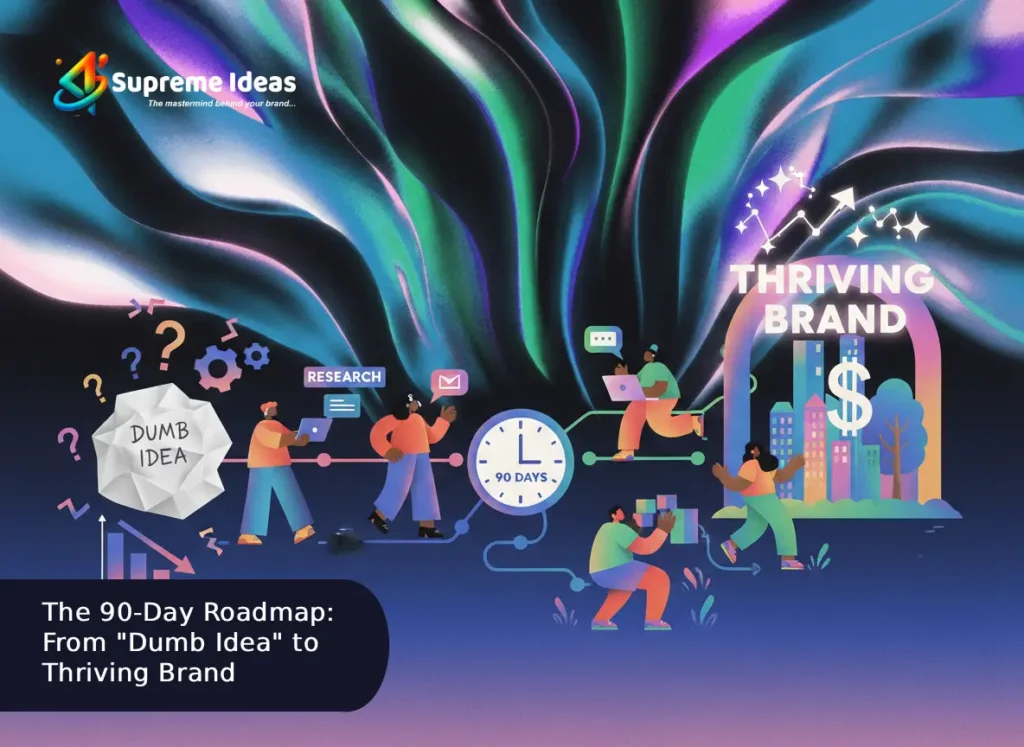
this is a roadmap for the transition from hypothesis to reality. it’s 90 days of aggressive unlearning, market collision, and building a foundation that can actually hold weight. if you’re looking for motivational fluff, go to LinkedIn. if you want to build a machine, keep reading.
Phase 1 (Days 1-30): The Unlearning and Discovery
the first thirty days are about one thing: killing your ego. you have to stop thinking of yourself as a “CEO” and start thinking of yourself as a detective. you don’t have a business yet. you have a set of assumptions. your job in month one is to try and disprove those assumptions as fast as possible.
The “Painkiller vs. Vitamin” Audit
we’ve talked about this before, but we need to go deeper. a vitamin is something that makes life slightly better. a painkiller is something that stops a bleeding wound. most founders build vitamins because they’re easier to imagine. but painkillers are what people pay for in a recession.
-
Misconception: People beleive that “value” is enough to make a sale. it’s not. value is subjective. pain is objective.
-
The Good Approach: Finding a problem so frustrating that people are already trying to solve it with a “shostring” workaround. if they’re using three different spreadsheets and a manual calendar to solve a problem, they have a pain.
-
The Bad Approach: Starting with the solution. “i want to build an AI for dog walkers.” why? are dog walkers suffering? or do you just like AI?
The Customer Discovery Call (Done Right)
most discovery calls are useless because the founder is “pitching” the whole time. they ask leading questions like, “wouldn’t it be great if you had an app that did X?” of course the person says yes—they want to be polite.
you need to use what i call the “Anti-Pitch.” you ask about their past behavior, not their future intentions.
-
Wrong: “Would you pay for a tool that organizes your receipts?”
-
Right: “How did you handle your receipts last month? How long did it take? How much did that time cost you? What else did you try to use to fix that?”
if they haven’t tried to fix it yet, it’s not a real problem. move on. your goal is to talk to 50 people in 30 days. no really, 50. if you aren’t willing to talk to 50 strangers, you aren’t ready to run a company.
Finding the “Friction”
during these 50 calls, you aren’t looking for praise. you are looking for “Friction.” what is the one thing they keep complaining about? what is the thing that makes them sigh in frustration? that sigh is where the profit lives. by day 30, you should be able to describe your customer’s problem better than they can. that is the foundation of authority.
Phase 2 (Days 31-60): The Market Collision
month two is where the “dumb idea” meets the pavement. this is the most terrifying phase because this is where you ask for money. up until now, it’s just been talk. now, we look for “Minimum Viable Evidence” (MVE).
The MVE vs. The MVP
everyone talks about the Minimum Viable Product. i think that’s a mistake for bootstrappers. a product takes time and money to build. an MVE is just evidence that people want it.
-
The Bad Approach: Building a basic version of the app (the MVP) and then trying to find users.
-
The Good Approach (The Smoke Test): Building a landing page that looks like the product already exists. it explains the benefit, shows a price, and has a “Buy” button.
Cash as the Only Truth
when someone says, “i’d totally buy that,” they are lying. they are being nice. when someone puts their credit card digits into a box and hits “submit,” they are telling the truth.
your goal in month two is to sell a “pre-order” or a “beta access” pass.
-
The Scenario: You’ve identified that small law firms struggle with document sorting. You build a landing page for “Sort-Bot.” You run $100 of ads. You offer a “Founder’s Lifetime License” for $200.
-
The Result: If you sell 10 licenses, you have $2,000 and, more importantly, you have 10 people who have proven your idea is not dumb. if you sell zero, you just saved yourself two years of building a ghost town.
The Nuance of the Offer
most founders fail here because their offer is weak. they say “sign up for our newsletter.” lol. nobody wants more email. you need to offer a specific result for a specific price.
-
Weak Offer: “Better document management for lawyers.”
-
Strong Offer: “We will sort your last 1,000 legal documents in 24 hours or you don’t pay. Pre-order the Sort-Bot beta now for $199.”
this is a collision. it’s violent. it’s honest. it’s the only way to know if you have a thriving brand or a dead-on-arrival project… or maybe you just haven’t found the right words yet.
Phase 3 (Days 61-90): The Foundation and Infrastructure
if you survived month two—meaning you actually have cash in the bank from strangers—now you build. but you don’t build a “company” in the traditional sense. you build a machine.
Building the “V0” (Version Zero)
you have 30 days to deliver what you promised. this is where “shostring” thinking is vital. do not hire a full-time dev. do not buy a five-thousand-dollar tech stack.
-
The Strategy: Use “No-Code” tools or manual labor. if you promised an automated sorter, you might have to spend your nights manually sorting those documents yourself. that’s fine. it’s “Mechanical Turk” style. you are the automation.
-
Why? because by doing it manually, you learn the edge cases. you see the problems that an automated system would miss. you are becoming an expert in the “how” while you deliver the “what.”
The Systems of Growth
now that you have customers, you need a way to get more. this is where you build your “Growth Flywheel.”
-
Retention Loop: How do you make sure the first 10 customers are so happy they tell 10 more? (High-touch onboarding, personalized notes, over-delivering on speed).
-
Referral Engine: Give them a reason to share. “Get one month free for every firm you refer.”
-
Content Authority: Start documenting the process. “How we sorted 10,000 documents in a weekend.” this is how you build a brand that sticks.
The Logic of the “Thriving Brand”
a brand is not a logo. a brand is the “Trust Gap.” it’s the distance between what you say you’ll do and what the customer expects you to do. if you close that gap every single time, you have a brand.
most founders misunderstand “scaling.” they think scaling is about more ads. scaling is actually about making sure your systems don’t break when you go from 10 customers to 100. in month three, you are documenting every step. you are creating SOPs (Standard Operating Procedures) even if you’re the only one reading them. you are preparing for the day you aren’t the one doing the work.
The Psychology of the Pivot
somewhere in these 90 days, you will likely realize that your first idea was wrong. this is the “Pivot Point.”
-
Bad Approach: Staying the course because you already spent money on the domain name and told your friends you were building an AI for dog walkers. this is “Sunk Cost Fallacy.” it’s teh fastest way to go bankrupt.
-
Good Approach: Looking at the data. if the dog walkers didn’t care about AI but kept asking if you knew any good insurance providers… you stop building AI and you start building an insurance marketplace for pet professionals.
adaptability is your only real protection against failure. the 90-day roadmap is designed to force these pivots early. i mean—it’s intresting how many people think a pivot is a failure. a pivot is actually a graduation. it means you’ve learned something the rest of the market doesn’t know yet.
Common Objections and Reality Checks
“90 days is too fast to build anything real.” it’s not too fast to build a foundation. most of what people do in the first year of a business is just “playing office.” they’re doing things that don’t matter. if you focus ruthlessly on validation and sales, 90 days is a lifetime.
“What if i can’t find 50 people to talk to?” then you don’t have a market. or you’re too shy to be a founder. go to where your customers hang out. Reddit, LinkedIn, trade shows, coffee shops near their offices. if you can’t find them to talk to them, you won’t be able to find them to sell to them.
“I need funding to build the V0.” no, you don’t. if you can’t solve the problem manually or with no-code tools, you probably don’t understand the problem well enough yet. funding should be used to pour gasoline on a fire that is already burning. don’t try to use a match to start a fire in a hurricane of unproven assumptions.
Conclusion: The Founder’s Evolution
at the end of these 90 days, you will not be the same person you were on day 1.
on day 1, you were a dreamer with a “dumb idea.” you were hopeful, naive, and probably a bit arrogant. on day 90, you are a founder with a brand. you have scars from the discovery calls. you have the data from the smoke tests. you have the systems from the V0 delivery.
the core principle of the 90-day roadmap is Speed to Truth. the market doesn’t care about your feelings, your five-year plan, or your “passion.” it only cares about results. by following this roadmap, you’ve stopped guessing and started building a machine that responds to reality.
even if you didn’t hit $10k in MRR (Monthly Recurring Revenue) by day 90, you have something more valuable: a validated direction. you know where the pain is. you know what the market will pay for. and you have the infrastructure to deliver it.
…now, you just have to keep going. because day 91 is where the “thriving” part actually starts to scale. just don’t get comfortable. the minute you stop validating is the minute the 1,825-day clock starts ticking again.
anyway, that’s the roadmap. go get your hands dirty.